 注: 建议图片大小150px*50px
  注: 建议图片大小150px*50px

Views: 0 Author: Site Editor Publish Time: 2026-06-29 Origin: Site


Cooking over fryers, flat-top grills, and charbroilers inside a small mobile space produces intense heat. Heavy smoke and thick grease vapors build up rapidly during typical service hours. This presents an immediate operational challenge for food truck owners.
Standard roof vents or residential-grade fans cannot safely or legally handle this output. Using inadequate equipment causes severe fire hazards, unbearable internal temperatures, and guaranteed health inspection failures. A poorly ventilated trailer puts your staff at risk and shuts down your business before it opens.
You need a code-compliant food trailer ventilation system engineered specifically for high-grease applications. This system must extract hazardous fumes effectively while enduring constant road vibrations. This guide provides a technical roadmap for evaluating and procuring the exact hood setup your menu demands.
Mobile kitchens face unique ventilation hurdles. Traditional brick-and-mortar kitchens rely on massive rooftop exhaust units and extensive ductwork. Mobile setups must replicate this power within a highly restricted footprint. You operate in a compact space. Your power supplies rely entirely on onboard generators or limited shore power. Furthermore, highway speeds generate intense aerodynamic drag. This drag places severe stress on external roof-mounted fans and ventilation stacks.
Atomized grease from a fryer food trailer or a busy grill food trailer creates severe danger. Frying foods releases millions of microscopic grease particles into the air. These particles travel upward and coat interior surfaces rapidly. This accumulation builds a massive fire risk over a short period. Heavy grease layers also degrade expensive equipment. It infiltrates refrigeration coils, ruins electrical panels, and forces premature equipment failure.
We must define what a successful installation actually achieves. First, it passes your local fire marshal inspection without delays. Inspectors look closely at welded seams and fire suppression integration. Second, it maintains a workable ambient temperature. Your staff cannot function safely in a 120-degree metal box. Third, a proper setup captures 100 percent of the smoke and grease plume continuously. Smoke should never escape the hood canopy and roll across the ceiling.
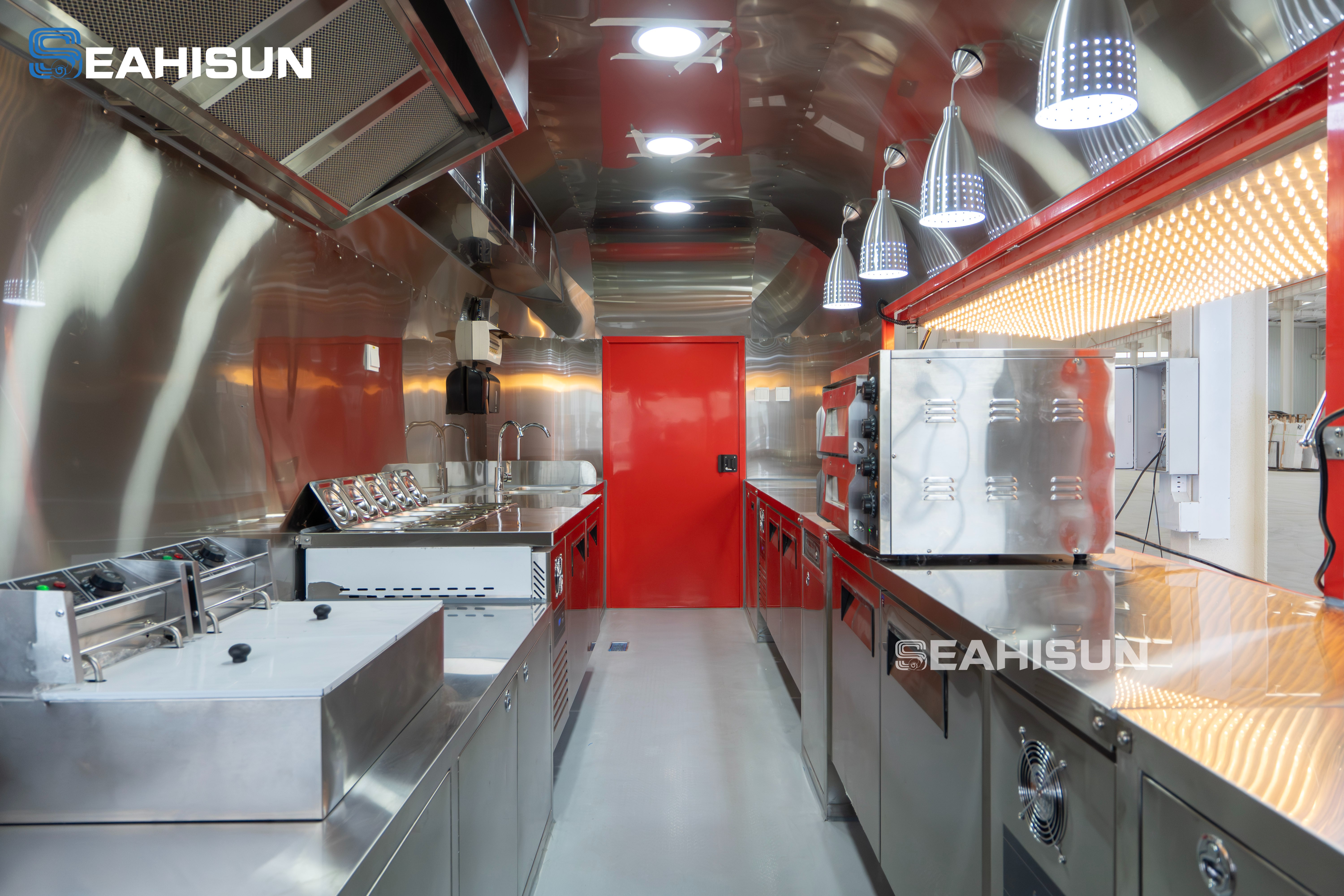
Navigating commercial hood categories often confuses new operators. You must select the right hood classification for your specific menu. Installing the wrong hood type leads to immediate inspection failures.
Type 1 hoods represent the mandatory choice for frying and grilling. These systems extract grease, smoke, and intense heat. Manufacturers build Type 1 units using thick stainless steel. They feature fully welded seams. Liquid-tight seams ensure grease cannot leak out and ignite inside the wall cavity. These hoods utilize specialized baffle filters. Baffles force rising air to change direction quickly. Heavy grease droplets cannot make the turn, so they crash into the metal baffles and drain safely away.
Type 2 hoods serve an entirely different purpose. They only handle non-grease heat and moisture. You might install a Type 2 hood over a commercial dishwasher, a pasta cooker, or a large coffee machine. They lack grease baffles and liquid-tight welds. Explicitly stating this rule is vital: installing a Type 2 hood over a grill or fryer results in an immediate code violation. The system will catch fire eventually.
Upblast exhaust fans complete the extraction process outside the trailer. Commercial ventilation rules dictate vertical discharge. The fan must shoot the greasy air straight up into the atmosphere. It pushes exhaust away from the roofline. If you use a standard side-venting fan, grease will pool heavily on your trailer roof. This creates environmental hazards and damages the trailer exterior.
| Feature | Type 1 Hood | Type 2 Hood |
|---|---|---|
| Target Extraction | Grease, Smoke, Heat | Steam, Heat, Odors |
| Material Construction | Stainless steel, fully welded seams | Galvanized or stainless, riveted seams |
| Filter System | Heavy-duty grease baffles | Mesh filters or no filters |
| Fire Suppression | Required (ANSUL system) | Not typically required |
| Menu Applications | Burgers, fries, steaks, wok cooking | Pasta, soup, coffee, baking |
Purchasing the correct size matters just as much as buying the right type. An undersized hood fails to capture smoke. An oversized hood wastes precious generator power and space.
Calculating hood dimensions relies on a standard industry rule. The hood canopy must overhang your cooking equipment by at least 6 inches on all open sides. Smoke plumes expand outward as they rise. If your flat-top grill spans 36 inches, your hood must span at least 48 inches to capture the outward drift. Wall-mounted equipment needs overhangs on the front and both sides.
Cubic Feet per Minute (CFM) measures airflow volume. You calculate required CFM based on your hood length and the severity of your cooking equipment. Heavy-duty equipment like charbroilers demands higher CFM than standard flat-tops. You multiply the linear length of your hood by a specific CFM factor.
Here is a crucial caveat. Avoid simply buying the fan boasting the highest CFM rating. Over-exhausting a small mobile space causes severe problems. Intense negative pressure pulls dirt in from outside. It extinguished pilot lights and strains the fan motor unnecessarily.
| Cooking Equipment Category | Example Appliances | Estimated CFM Required (per linear foot of hood) |
|---|---|---|
| Light Duty | Ovens, Steamers, Kettles | 200 CFM |
| Medium Duty | Flat-top Grills, Standard Fryers | 300 - 400 CFM |
| Heavy Duty | Charbroilers, Woks, Upright Broilers | 400 - 600 CFM |
| Solid Fuel | Wood-fired Grills, Smoker Ovens | 600+ CFM |
Clearance to combustibles represents another strict fire code parameter. Exhaust ductwork radiates intense heat. Fire codes typically demand 18 inches of clearance between grease ducts and any combustible trailer materials. You can reduce this clearance by installing approved heat shields or using specialized zero-clearance insulation wraps.
Many builders focus entirely on pulling air out. They forget to bring air back in. This oversight creates severe operational risks.
The vacuum effect occurs when you extract air without replacing it. If your exhaust hood pulls out 1,500 CFM, you must reintroduce 1,500 CFM into the trailer. This balance ensures proper mobile kitchen ventilation. Without a dedicated make-up air system, the trailer enters negative pressure. Doors become incredibly difficult to open. The exhaust fan motor strains and burns out prematurely. Worst of all, negative pressure can pull lethal carbon monoxide backward out of gas appliance flues directly into your workspace.
We solve this by balancing the system effectively. Consider the following steps to manage airflow:
Virtually all municipalities require integrated fire suppression for fryers and grills. Local inspectors expect to see an automatic system hard-piped directly into the Type 1 hood. These systems utilize chemical tanks. You must account for the space and weight of these steel tanks during your build. Position the pull-station near the exit door for quick access during emergencies.
Electrical load considerations play a massive role in mobile setups. Commercial exhaust fans and make-up air blowers draw significant amperage. A 1-horsepower fan might require 16 amps upon startup. You must calculate the combined continuous running load and the peak startup load. Ensure your portable generator or shore-power connection handles this demand without tripping breakers mid-service.
Procuring a robust system requires careful vendor evaluation. Never buy cheap, uncertified equipment from unknown online marketplaces. High-quality systems protect your business.
Advise your procurement team to shortlist manufacturers holding proper certifications. Your equipment must carry NSF (National Sanitation Foundation) listings for health compliance. It also needs ETL or UL listings for electrical safety. Inspectors actively search for these metal data plates during initial reviews. Missing plates guarantee a failed inspection.
You must decide between custom and pre-fabricated models. Buying an off-the-shelf hood saves time initially. However, stock hoods rarely fit the unique curves or low ceiling heights of an exhaust hood trailer perfectly. Ordering a custom-fabricated unit ensures precise fitment. Custom units maximize headroom and integrate seamlessly over your specific cooking line.
Ask manufacturers direct questions before submitting payments. Key inquiries include:
Cutting corners on a food trailer ventilation system remains the most common reason new mobile food businesses fail their initial inspections. Health and fire marshals show zero leniency toward improper grease extraction. Their strictness protects you and your customers from catastrophic fires.
Matching a fully welded Type 1 hood, properly calculated CFM exhaust rates, and a balanced make-up air fan guarantees success. This combination creates a safe, code-compliant, and comfortable operational environment. Your staff will perform better in a cool, smoke-free kitchen. Your equipment will last significantly longer without heavy grease buildup.
Consult with a commercial kitchen ventilation engineer before buying your cooking appliances. They will help you map out exact spatial requirements. Request a custom quote based on your specific equipment lineup to secure a system built exactly for your mobile business needs.
A: No. Residential hoods lack the CFM power, grease-trapping baffles, and heavy-duty construction required for commercial frying and grilling. Installing a residential unit violates fire codes, nullifies your insurance, and creates a severe fire hazard inside a mobile kitchen.
A: You generally need 300 to 400 CFM per linear foot of the hood for medium-duty equipment like grills and fryers. However, actual requirements depend heavily on exact equipment BTU ratings, hood depth, and specific local fire code mandates.
A: In most jurisdictions, yes. Without make-up air, your exhaust fan struggles to pull out smoke. The resulting negative pressure makes doors hard to open and risks drawing lethal carbon monoxide from gas equipment backward into your trailer.
A: You must clean the metal baffle filters daily using degreaser and hot water. The internal ductwork and the rooftop upblast fan require professional deep cleaning and degreasing typically every 3 to 6 months, depending heavily on your daily frying volume.

