Operating a high-volume taco business requires more than just a standard kitchen on wheels. It demands an assembly-line workflow optimized for rapid order fulfillment and high-heat cooking. When ticket times shrink to mere seconds, your physical space must support seamless movement. Generic layouts often fail taco vendors by under-sizing the crucial griddle space. They frequently lack sufficient cold prep capacity for diverse garnishes. Additionally, poorly installed serving windows routinely bottleneck customer handoffs during peak dinner rushes. This guide breaks down the essential equipment specifications, spatial layouts, and serving window configurations required for long-term success. You will discover how to match your flat-top grill to expected customer volume. We also explore strict health department compliance rules regarding ventilation and plumbing. By the end, you will know exactly how to build a compliant, high-efficiency mobile taco operation.
Key Takeaways
- Workflow Dictates Layout: A successful taco operation requires a linear layout moving from cold storage to the griddle, to the prep table, and finally to the serving window.
- Griddle Capacity is the Bottleneck: Sizing your flat-top griddle correctly is the single most critical equipment decision for a taco vendor.
- Window Specs Impact Compliance: Concession windows must balance customer interaction with strict local health codes regarding screens and pest control.
- Power and Heat Management: High-output cooking requires commercial-grade ventilation and carefully calculated generator capacities to prevent mid-service failures.
The Anatomy of a High-Volume Taco Food Trailer
Taco menus are characterized by fast ticket times and high customization. Customers expect rapid service even when ordering complex, personalized meals. A poorly planned taco food trailer layout leads to crossed paths inside the kitchen. This slows down service and increases staff fatigue during busy shifts.
To eliminate these bottlenecks, operators must adopt an assembly-line approach. You design the floor plan so raw ingredients move in a straight, uninterrupted line toward the customer.
The Assembly Line Approach
We divide the mobile kitchen into four distinct functional zones. Each zone serves a specific purpose in the taco-building process.
- Zone 1: Raw Storage & Prep. This area houses your upright refrigeration. It holds raw meats, bulk produce, and backup ingredients. Staff pull from here to feed the cooking station.
- Zone 2: The Hot Zone. This is your primary cooking area. Staff cook raw proteins and warm fresh tortillas here simultaneously.
- Zone 3: The Build Station. Once cooked, proteins move to the assembly area. Staff assemble tacos using a cold prep table filled with salsas, cilantro, and onions.
- Zone 4: The Expo/Serving Area. Fully assembled plates arrive at the window. Staff process payments and hand off orders to the customer.
Strategic Space Allocation
Taco vendors should dedicate at least 40% of their total floor plan to the "Build Station" and hot holding areas. Why? Tacos cook extremely fast, but assembling them takes careful coordination. If you lack space to line up open tortillas and apply garnishes, your cooks will outpace your assemblers.
You should also minimize deep-fryer space unless churros or hard-shell tacos are core menu items. Fryers consume valuable hood space. They generate excess heat. Reallocating this footprint to a larger prep table yields much higher operational efficiency.
Common Mistakes in Layout Design
Many first-time operators place the refrigerator directly behind the griddle. This forces the cook to step backward, blocking the aisle. It causes dangerous collisions during peak rushes. Always keep cold storage beside the cook station, not behind it.
Core Cooking Equipment for a Griddle Food Trailer
The flat-top griddle, or plancha, is the undisputed engine of any taco operation. Selecting the right size directly dictates your maximum hourly revenue. If you plan to operate a high-yield griddle food trailer, every inch of cooking surface matters.
Sizing the Flat-Top Griddle
You must evaluate your griddle based on two main dimensions: width and plate thickness. Width determines how many items you can cook at once. Plate thickness determines how well the griddle recovers heat after you drop cold meat onto it.
| Griddle Width | Ideal Team Size | Output Capacity | Best Use Case |
| 36-Inch | 1-2 Cooks | Medium (Good for standard service) | Zoning half for meats, half for tortillas. |
| 48-Inch | 2-3 Cooks | High (Ideal for festivals/catering) | Dedicated meat searing zones, large tortilla warming areas. |
A standard 36-inch griddle allows you to create two distinct temperature zones. You sear carne asada on high heat on one side. You warm tortillas on medium-low heat on the other. However, if you regularly serve lines of 50 or more people, a 48-inch griddle becomes absolutely essential.
Thickness is equally critical. You need a 3/4-inch to 1-inch thick steel griddle plate. Thin plates warp under high heat. They also lose temperature rapidly when covered in cold, marinated proteins. A thick plate retains thermal mass, ensuring a consistent sear throughout a busy service.
Steam Tables (Bain-Marie) Integration
You cannot cook every protein to order. High-volume ingredients like al pastor, carnitas, barbacoa, and refried beans require long cook times. They must be held hot and ready for immediate service. Steam tables keep these pre-cooked proteins at safe, FDA-compliant temperatures (above 135°F) without drying them out.
Ventilation & Fire Compliance
High-output cooking generates massive amounts of grease-laden vapor. You must install a Type 1 commercial hood system. Local codes mandate sizing the hood to extend at least six inches beyond the edges of your cooking equipment. You must also integrate an ANSUL fire suppression system. This system specifically protects the griddle and any auxiliary burners from grease fires.
Refrigeration and Prep Stations for Fast Food Trailers
Implementation realities inside mobile kitchens are harsh. During peak summer services, ambient temperatures near the griddle can exceed 110°F. In the high ambient heat of a fast food trailer, standard residential-grade refrigeration will quickly fail. You must invest in heavy-duty commercial units.
The Mega-Top Sandwich/Salad Prep Table
Standard prep tables simply aren't enough for taco vendors. A typical burger vendor might need four ingredient pans. A taco vendor easily needs ten. You require maximum 1/6 and 1/9 pan capacity to organize diverse ingredients efficiently.
- 1/6 Pans: Ideal for high-turnover items like diced onions, shredded lettuce, and pico de gallo.
- 1/9 Pans: Perfect for potent garnishes like spicy salsas, fresh cilantro, lime wedges, and crumbled cotija cheese.
You must select prep tables featuring insulated lids. When closed during slow periods, these lids trap cold air. They ensure your garnishes maintain FDA-compliant cold holding temperatures (below 41°F) regardless of external weather conditions.
Undercounter vs. Upright Refrigeration
Balancing cold storage requires strategic placement. Upright refrigerators offer maximum vertical volume. They excel at holding bulk raw meats, extra produce boxes, and backup salsa buckets. However, placing them near the serving window disrupts workflow.
Conversely, undercounter refrigerators fit perfectly beneath the point-of-service counters. They minimize staff movement. Cooks simply reach down to grab a fresh batch of marinated chicken instead of walking across the kitchen. A well-designed trailer uses both: uprights for bulk backup, and undercounter units for immediate line replenishment.
Concession Serving Windows: Specs, Security, and Flow
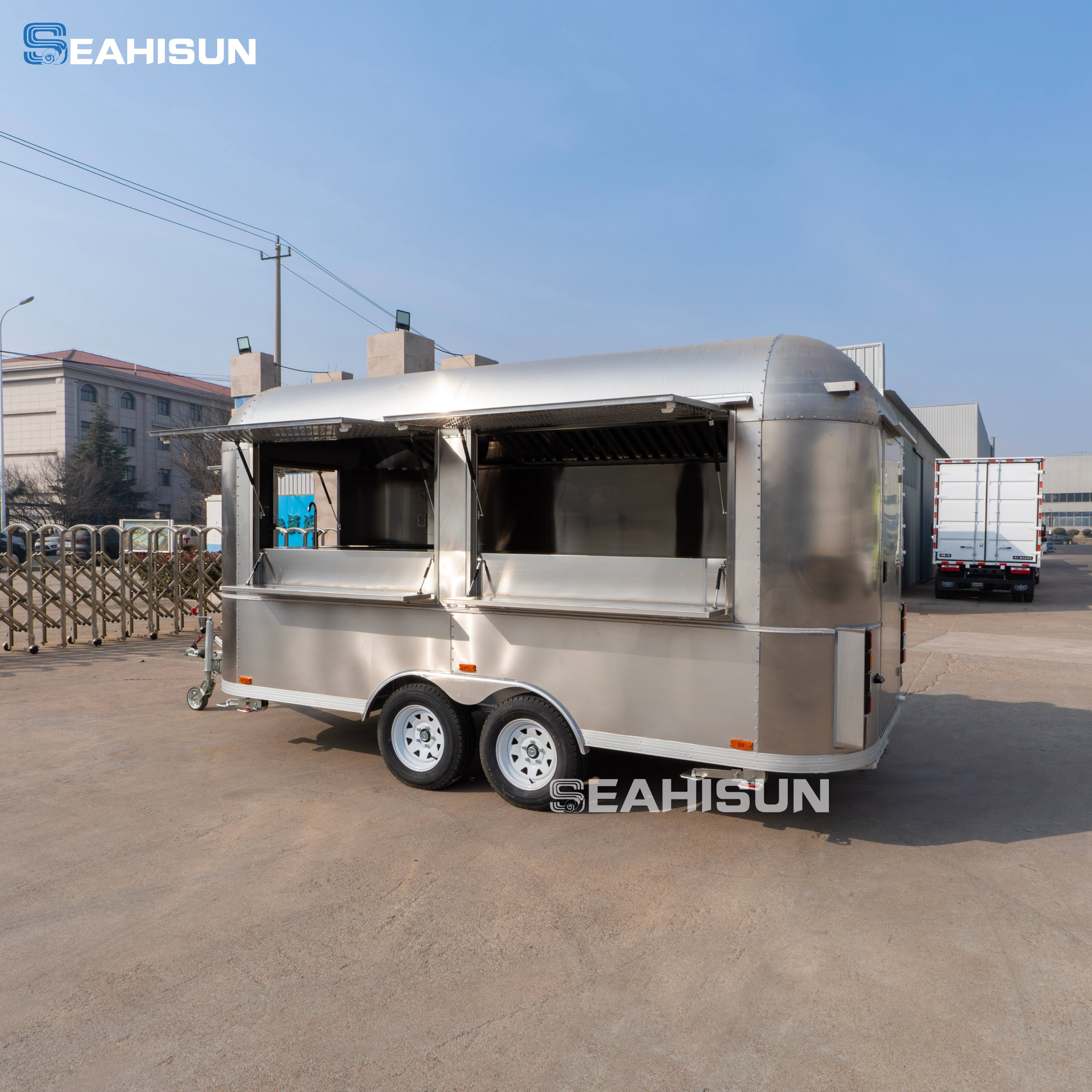
The serving window bridges the critical gap between your kitchen and the customer. It serves multiple purposes simultaneously. It must facilitate clear communication, protect your patrons from harsh weather, and strictly meet local health codes. Evaluating window styles is vital when designing a custom vending trailer.
Comparing Window Styles
Vendors generally choose between two primary concession window configurations based on their climate and service style.
| Window Style | Key Features | Primary Benefit |
| Awning Windows (Gas Struts) | Hinged at the top, lifts outward. | Provides natural rain and sun protection for waiting customers. |
| Sliding Glass Tracks | Multiple glass panels sliding horizontally. | Allows excellent climate control inside the trailer during slow periods. |
Many premium builds combine both. They feature an exterior metal awning that lifts via gas struts, revealing interior sliding glass panels. This dual approach offers maximum flexibility.
Health Code & Pest Compliance
County health inspectors rigorously examine serving windows. Their primary concern is pest control. You must integrate specific features to pass these inspections.
- Self-Closing Mechanisms: Many jurisdictions require transaction windows to close automatically when not held open by an employee.
- Air Curtains (Fly Fans): These fans blow a continuous stream of high-velocity air downward across the window opening. They prevent flies from entering the kitchen.
- Mesh Screens: If you operate near parks, lakes, or beaches, inspectors often mandate fine mesh screens over any open ventilation areas.
Security Features
Mobile kitchens contain thousands of dollars in equipment. Security is non-negotiable. Evaluate strong internal locking mechanisms for all sliding tracks. Install tempered safety glass to resist shattering. Finally, utilize exterior fold-down metal covers. You lock these covers firmly in place during overnight parking to deter break-ins and protect the glass from road debris during transit.
Utilities, Plumbing, and Compliance Realities
Never finalize your taco truck or trailer build without cross-referencing your specific county's mobile food facility requirements. Health codes vary wildly between cities. Overlooking a minor plumbing detail can delay your opening by months.
Plumbing Specifications
Plumbing codes revolve entirely around sanitation and water management. The most universal requirement is the 3-compartment sink rule. You must install a sink large enough to wash, rinse, and sanitize your largest piece of equipment. If you use a massive 48-inch griddle, your sink basins and adjacent drainboards must physically accommodate your largest griddle scraper or prep pan.
Furthermore, you must adhere to strict water tank ratios. Industry standards and legal requirements dictate water storage capacities. Your gray water tank (wastewater) must be at least 15% larger than your fresh water tank. If you carry 40 gallons of fresh water, you must install a gray water tank holding at least 46 gallons. This prevents overflow scenarios inside a busy mobile taco trailer.
Power & Propane Considerations
Electrical failures mid-service destroy profitability. When sizing your generator, you must calculate starting watts, not just running watts. A commercial refrigerator compressor requires a massive power spike to turn on. If your generator only accounts for steady running watts, it will trip the breaker every time the fridge cycles on.
Best Practices for Propane
Your flat-top griddle and hot water heater rely heavily on gas. You need safe mounting locations for dual 100lb propane tanks. Mount these tanks externally on the trailer tongue. Ensure they sit within a reinforced steel cage. This location provides ample ventilation, protects tanks from rear-end collisions, and allows easy access for refilling between events.
Conclusion
Building a highly efficient mobile taco operation requires intentional design and commercial-grade equipment. Your success hinges entirely on how fast you can process orders without compromising food quality or safety.
- Prioritize High-Yield Assets: Focus your budget on a thick-plate, high-recovery griddle, a robust Type 1 commercial hood, and a high-capacity refrigerated prep table. These pieces directly generate revenue.
- Map Your Exact Assembly Process: Before purchasing any equipment, physically map out your step-by-step assembly line. Ensure your staff will not cross paths during service.
- Engage Local Authorities Early: Request the specific mobile food code handbook from your local health department today. Build your plumbing and window specifications around their exact legal requirements.
By treating your mobile kitchen as a precision assembly line, you eliminate operational friction. This allows your team to focus entirely on delivering exceptional food to your customers.
FAQ
Q: What size flat-top griddle do I need for a taco trailer?
A: You should focus on a 36-inch minimum griddle for effective dual-zone cooking. This allows you to sear raw meats on high heat on one side while warming tortillas on lower heat on the other. For extremely high-volume festival operations, upgrade to a 48-inch griddle.
Q: Do taco trailers require a specialized exhaust hood?
A: Yes. Because you cook raw meats and produce heavy grease vapors, health and fire codes require a Type 1 commercial exhaust hood. This hood must integrate an automated fire suppression system to protect against dangerous grease fires.
Q: What are the standard dimensions for a food trailer serving window?
A: Standard serving window dimensions typically start at 36" x 36" for smaller setups. High-volume operations often utilize larger configurations up to 36" x 72". Larger windows improve customer interaction and allow two staff members to expedite food simultaneously.
Q: Can I use standard restaurant equipment in a mobile taco trailer?
A: No. You must use NSF-certified, mobile-rated equipment. Standard equipment lacks the reinforced structural integrity needed to withstand constant road vibrations. Mobile-rated equipment features proper leg-mounting capabilities, ensuring units bolt securely to the floor or counters.
 注: 建议图片大小150px*50px


