Investing in a mobile food business carries immense stakes. A poorly designed layout instantly caps your daily revenue. Worse, a non-compliant build delays your launch indefinitely while draining your capital. You must move past basic aesthetic considerations to ensure long-term profitability. True success requires intense focus on workflow engineering, strict regulatory compliance, and rugged equipment durability.
We created this comprehensive guide to give you a clear, evidence-based framework. You will learn how to accurately evaluate builders before signing contracts. We will show you how to select the right platform for your unique menu constraints. Finally, you will discover how to precisely align the physical build of your kitchen directly to your daily operational goals. Prepare to design a mobile unit built for maximum output.
Key Takeaways
Base your blueprint entirely on your menu constraints, focusing on the peak-hour prep-to-window workflow.
Prioritize mechanical infrastructure (generator capacity, hood ventilation, weight distribution) over cosmetic exterior features.
Local health and fire codes dictate structural requirements; verify regional compliance before approving any builder's CAD drawings.
Vet manufacturers based on engineering transparency, warranty terms, and post-delivery support rather than just the lowest initial quote.
Defining Your Menu and Workflow Before Food Truck Customization
Successful mobile operators never pick a vehicle size first. They start by analyzing their food. You must master your operational needs before beginning the food truck customization process. Every inch of your floor plan must serve a specific, high-volume purpose.
Reverse-Engineering the Menu
Map out exactly what equipment you need to produce your core menu items. You must calculate this based on maximum capacity during a two-hour rush. If your signature item is a fried chicken sandwich, you cannot rely on a single standard residential fryer. You need commercial-grade, high-recovery fryers. List every appliance, from under-counter refrigerators to specialized flat-top grills. Attach precise dimensions and power requirements to each item.
The Mobile Kitchen Triangle
Traditional commercial kitchens rely on a classic workflow triangle involving prep, cook, and serve stations. You must adapt this concept to a linear, heavily confined space. Your goal is to minimize staff crossover. Cooks should never bump into cashiers. A well-engineered layout flows naturally from cold storage to the prep counter, directly into the cooking line, and finally to the serving window. This linear flow prevents collisions and shaves seconds off every ticket.
Storage vs. Production Ratios
You must balance raw ingredient storage against active cooking space. Too much refrigeration leaves you with inadequate grill space during a rush. Too much grill space means you run out of ingredients mid-shift. Analyze your daily sales projections. Determine exactly how many cubic feet of cold storage will hold you over without needing a mid-day restock.
Success Criteria
Consider this phase complete only when you possess a finalized, itemized equipment list. You must also establish a clear understanding of the minimum square footage required to house your staff and equipment safely. This data dictates your next major decision.
Choosing Your Base: Step Vans vs. Custom Mobile Kitchen Trailers
Once you understand your spatial requirements, you must choose a vehicle platform. You generally choose between a motorized step van and a towable trailer. Each option drastically impacts your daily operations and initial capital requirements.
Step Vans (The Traditional Food Truck)
Step vans represent the classic street food aesthetic. They offer all-in-one mobility. You can easily navigate them through tight urban corridors.
Pros: They fit into standard street parking spots easily. They provide a massive, cohesive canvas for brand wrapping. You do not need a separate heavy-duty towing vehicle.
Cons: They require a significantly higher upfront cost. Engine failure is catastrophic. If the van breaks down, your entire kitchen goes to the mechanic, pausing all revenue generation.
Concession Trailers
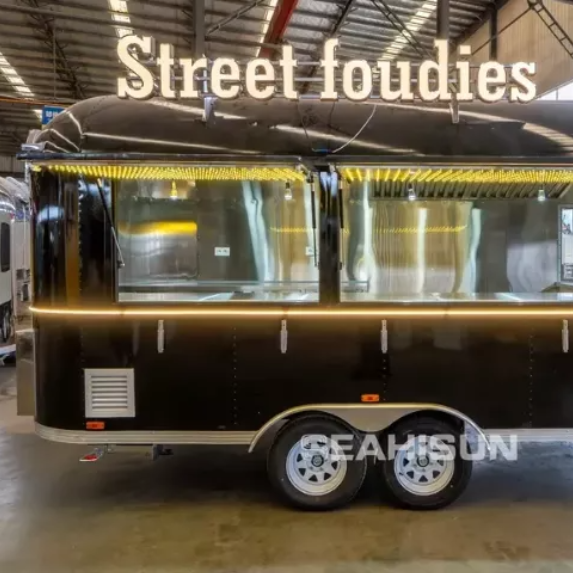
A towable custom mobile kitchen often provides more square footage per dollar spent. They excel in stationary or semi-permanent placements like food truck parks or large festivals.
Pros: They carry a much lower initial entry cost. They offer larger footprints for high-volume commercial equipment. If your tow vehicle breaks down, you can simply rent or borrow another truck to move your kitchen.
Cons: You must purchase or lease a heavy-duty tow vehicle. They require advanced driving skills to reverse and maneuver. Many dense urban parking zones restrict trailers.
Base Comparison Summary
Feature | Step Van | Concession Trailer |
Initial Cost | High | Low to Medium |
Mobility | Excellent for dense cities | Better for static events/parks |
Mechanical Risk | High (Engine disables kitchen) | Low (Simply swap tow vehicles) |
Space Capacity | Limited by standard chassis sizes | Highly scalable (up to 30+ feet) |
Payload Capacity Considerations
Never ignore the Gross Vehicle Weight Rating (GVWR). The GVWR is the maximum legal and safe weight of your vehicle. You must calculate the combined weight of your commercial equipment, heavy steel fabrication, full water tanks, and staff. Water weighs roughly 8.3 pounds per gallon. A 50-gallon tank adds over 400 pounds. Exceeding the payload capacity causes catastrophic axle failure and voids insurance policies.
Core Evaluation Criteria for a Customized Food Truck Build
Your exterior graphics might attract customers, but your mechanical infrastructure keeps them fed. When planning a customized food truck, prioritize reliable internal systems over superficial upgrades.
Power and Generator Sizing: Electrical failure ruins shifts. You must calculate both the total running watts and the starting watts for all equipment. Commercial refrigerators demand massive power spikes when their compressors turn on. Add up the maximum concurrent load and build in a 20% safety buffer. Under-sizing generators leads to tripped breakers and chronic equipment failure.
Ventilation and Fire Suppression: You must assess whether your menu requires a Type 1 or Type 2 commercial hood. Type 1 hoods manage grease-laden vapors from fryers and grills. Type 2 hoods handle heat and moisture from ovens or espresso machines. You also need an active make-up air system to prevent negative air pressure. Furthermore, ensure your ANSUL fire suppression system complies strictly with current NFPA (National Fire Protection Association) standards.
Plumbing Infrastructure: Health codes rigorously dictate water systems. You must design the proper ratio of fresh water to gray water tanks. Standard regulations require the gray water tank to be a minimum of 15% larger than the fresh water tank. This prevents catastrophic backups. Ensure builders install easily accessible exterior dump valves. If you operate in cold climates, mandate winterization capabilities like heated tank pads.
Interior Materials: Build for brutal environments. Every surface must withstand high heat, grease, and aggressive chemical sanitation. Evaluate NSF-approved materials. Use diamond plate flooring for slip resistance and durability. Demand food-grade stainless steel walls behind the cooking line to satisfy health inspectors and ensure rapid daily cleaning.
Navigating Health Codes, Fire Safety, and Compliance Requirements
You cannot simply build a beautiful kitchen and start selling. Bureaucratic approval determines your launch date. Regulatory bodies inspect mobile kitchens as strictly as brick-and-mortar restaurants.
The Locality Trap
Many new operators fall into the locality trap. They buy a used truck from another state, only to fail their local inspection. A unit built perfectly to code in Florida may instantly fail inspection in California. Regulations regarding sink sizes, aisle widths, and exhaust fans vary drastically by county.
Pre-Build Approvals
Never start cutting metal without written permission. You must submit comprehensive plan reviews to your local health and fire departments before fabrication begins. This submission packet typically includes professional CAD drawings, detailed plumbing schematics, and manufacturer spec sheets for every appliance. Getting these plans stamped and approved protects your investment from forced redesigns later.
L&I (Labor and Industries) Inspections
Your mobile unit is essentially a moving power plant and gas pipeline. State agencies strictly monitor mobile commercial structures. You must hire certified professionals to execute proper electrical wiring and perform high-pressure gas line testing. Inspectors will look for appropriate conduit usage, safely secured gas lines, and proper exterior shut-off valves.
Assumption to Avoid
Never assume a builder’s "standard build" automatically meets your specific county's regulations. Verify every dimension. Confirm that the required three-compartment sink features drainboards large enough for your specific local health department rules.
Vetting a Reliable Concession Trailer Manufacturer or Builder
The builder you choose acts as your primary business partner during the launch phase. Do not select a concession trailer manufacturer based entirely on the lowest initial quote. Cheap fabrication results in costly mid-season repairs.
Engineering Transparency
Professional builders provide deep engineering transparency. Require detailed floor plans, 3D renderings, and precise weight distribution schematics before you sign any contract. You need to see exactly where the wheel wells sit relative to your cooking line. Refuse to work with builders who only offer crude hand-drawn sketches.
Evidence of Expertise
Ask for verifiable case studies. Request to tour past builds that have been on the road for at least two years. New trucks always look shiny. A two-year-old truck reveals the true quality of the builder's craftsmanship. Look for cracking floor seams, failing rivets, and sagging exhaust hoods.
Warranty and Support
You must carefully evaluate the fine print on the manufacturer's warranty. Reputable builders explicitly separate warranties. You should see a distinct warranty for the vehicle chassis or trailer frame, another for the custom kitchen fabrication, and individual manufacturer warranties for the installed appliances. Clarify exactly who handles warranty labor if a custom-fabricated plumbing line leaks in month three.
Red Flags to Monitor
Demand for 100% upfront payment: Standard industry practice involves a structured deposit schedule tied to build milestones.
Refusal to provide milestone updates: A good builder sends weekly photo or video updates of the fabrication progress.
Lack of distributor relationships: Quality builders hold established accounts with commercial equipment distributors. If they ask you to buy your own appliances on Amazon, walk away.
Managing Build Timelines and Implementation Risks
Patience and vigilance ensure a successful build. You must actively manage the project timeline rather than passively waiting for a delivery date.
Supply Chain Realities: Always account for fluctuating lead times. Specialized commercial appliances often face backorders. Custom fabrication materials like heavy-gauge stainless steel can experience delivery delays. Add a realistic 30-day buffer to whatever launch date your builder promises.
Milestone Inspections: Do not wait until the final reveal to check the work. Schedule virtual or in-person walk-throughs at key construction phases. Inspect the raw framing before they install the walls. Check the rough-in plumbing and electrical lines. Review the final appliance installation. Catching a misplaced electrical outlet during the framing stage costs nothing. Moving it after the stainless steel walls go up costs hundreds of dollars.
The Shakedown Run: Mandate a rigorous "soft launch" testing phase at the manufacturer’s facility before taking final delivery. Turn on every appliance simultaneously to test the generator load. Run all the sinks to check water pressure and look for drain leaks. Fire up the exhaust hood to test the make-up air balance. Do not sign the final acceptance paperwork until the unit performs flawlessly under maximum operational stress.
Conclusion
A mobile kitchen is not just a vehicle; it is a complex micro-facility that demands rigorous planning and expert execution. Your success hinges entirely on your ability to merge a highly efficient workflow with bulletproof mechanical infrastructure. Avoiding shortcuts during the design phase and the builder vetting process will absolutely minimize expensive, frustrating post-launch retrofits.
Take action today. Finalize your menu workflow down to the square inch. Compile your exact equipment list. Once you hold that data, begin shortlisting three to five certified manufacturers to request initial floor plan consultations. Your operational foundation starts now.
FAQ
Q: How much does a fully customized food truck cost?
A: Costs vary wildly based on the platform and equipment. A high-end, ground-up build on a new step van can range from $100,000 to over $180,000. A custom concession trailer generally costs between $40,000 and $90,000. Be cautious of extremely low quotes, as they typically indicate residential-grade equipment or uncertified structural fabrication.
Q: How long does the food truck customization process take?
A: A standard custom build typically takes between 3 to 6 months. This timeline depends heavily on the builder's current backlog and global supply chain conditions for commercial appliances. Securing health department CAD approvals before fabrication can also add several weeks to the overall timeline.
Q: Can I finance a custom mobile kitchen?
A: Yes. Many specialized lenders offer equipment financing tailored to mobile food units. You can also explore SBA (Small Business Administration) loans. Securing favorable financing requires a comprehensive business plan, strong personal credit, and a detailed quote from a reputable, certified manufacturer.
Q: Can I buy a used truck and customize it later?
A: You can, but it carries immense risk. Retrofitting often uncovers hidden mechanical engine issues, rotting subfloors, and outdated wiring that fails modern fire codes. Ground-up custom builds ensure pristine infrastructure, compliant warranties, and a layout explicitly tailored to your specific menu.
 注: 建议图片大小150px*50px


