Food entrepreneurs face a harsh reality today. Traditional combustion-engine trucks demand massive upfront capital. They burn expensive fuel constantly. They require frequent, costly mechanical maintenance. Operators battle increasingly strict municipal parking regulations daily. You need a smarter, leaner way to launch your mobile culinary business. Enter the electric tricycle food truck. This highly agile vehicle dominates urban centers, sprawling college campuses, and pedestrian-heavy zones. It bypasses gridlock easily. It ignores the stringent emissions bans plaguing traditional commercial vehicles. You will learn how these agile carts drastically reduce your initial investment. They open exciting new revenue channels in previously restricted locations. However, to remain profitable, they require strict menu limitations. You must also implement precise power management strategies. We will explore the business case, core configurations, and essential technical specifications. Read on to master the framework for deploying your own compact mobile operation safely.
Key Takeaways
- Lower Barrier to Entry: Reduces initial investment and operational overhead compared to a standard mobile vending van.
- Power Management is Critical: Operational success hinges on separating the drivetrain battery from the commercial appliance power supply.
- Hyper-Targeted Menus: Best suited for single-category offerings (e.g., espresso, gelato, pre-packaged goods) rather than complex food prep.
- Regulatory Variability: Navigating local health codes (sink requirements, water storage) dictates the custom build out.
The Business Case: Compact Food Truck vs. Traditional Mobile Vending Van
Let us examine the financial reality of mobile gastronomy. A fully built-out combustion engine truck easily costs between $70,000 and $150,000. This heavy capital expenditure creates immense daily pressure. It forces operators to sell massive volumes just to break even. Conversely, a commercial-grade compact food truck ranges from $5,000 to $15,000. You retain vital cash flow. You can redirect these funds toward aggressive local marketing and high-quality inventory.
Operational expenditure drops significantly. You eliminate gasoline and diesel purchases entirely. You say goodbye to high automotive insurance premiums. Electricity costs remain minimal. You charge the batteries overnight during off-peak energy hours. Liability classifications often fall under bicycle or light electric vehicle categories. This regulatory shift dramatically improves your daily profit margins.
Location agility offers another massive advantage over a traditional mobile vending van. Heavy trucks cannot enter public parks. They cannot drive through narrow pedestrian zones. Property managers ban them from indoor corporate events due to exhaust fumes. An electric trike accesses all these highly lucrative, foot-traffic-dense areas. You bypass municipal parking restrictions easily. You bring the product directly to the consumer.
However, you must realistically address revenue ceilings. Small carts have strict physical volume limitations. Storage capacity restricts your total daily inventory. You must calculate expected daily transaction caps accurately. If your cart holds 150 items, your maximum daily revenue is strictly capped. Acknowledge this ceiling early in your business plan. Use it to set accurate, realistic return on investment timelines.
Financial and Operational Baseline Comparison | Operational Metric | Traditional Vending Van | Electric Tricycle Cart |
| Initial Investment | $70,000 – $150,000 | $5,000 – $15,000 |
| Operational Energy | Gasoline / Diesel | Grid Electricity |
| Location Access | Street parking, designated lots | Parks, indoors, pedestrian zones |
| Volume Capacity | High (1000+ items) | Low to Medium (100-300 items) |
Evaluating Core Configurations for Your Tricycle Food Truck
Your menu ultimately dictates your hardware. You cannot force a complex menu into a standard chassis. You must evaluate specific configurations for your tricycle food truck before finalizing any engineering plans. Attempting to retrofit a basic cart later usually leads to failure.
The Coffee & Espresso Trike
Coffee carts face significant, constant power challenges. Commercial espresso machines pull 2000 watts or more. Continuous heating elements drain batteries incredibly fast. You cannot run these machines off standard e-bike batteries. This configuration necessitates heavy-duty pure sine wave inverters. It requires large dual-battery setups. Often, operators must secure access to external shore power at the vending location. You plug the cart into a standard 110V or 220V outlet during service hours. This strategy keeps the espresso flowing without stranding your vehicle.
The Frozen & Cold Chain Vending Cart
Gelato, popsicles, and ice cream carts demand stringent temperature control. You must install heavily insulated holding cabinets. You need built-in commercial micro-refrigeration units. Success relies heavily on compressor efficiency. The system must maintain food-safe temperatures constantly. It must do this without draining the primary mobility battery. Modern cold-chain carts utilize advanced polyurethane insulation materials. They retain cold air excellently even when powered down briefly. This crucial feature protects your perishable inventory during transit.
Hot Food & Service Window Food Cart
Cooking raw meat safely on a trike is virtually impossible. A service window food cart is best suited for holding pre-cooked items. You use safe chafing dishes or low-draw electric warming cabinets. These components maintain safe temperatures without blowing internal fuses. Design considerations play a major role here. You need a sturdy fold-out service window. You require clean customer interaction counters to exchange payments. Protective awnings shield both the operator and the food from direct sunlight.
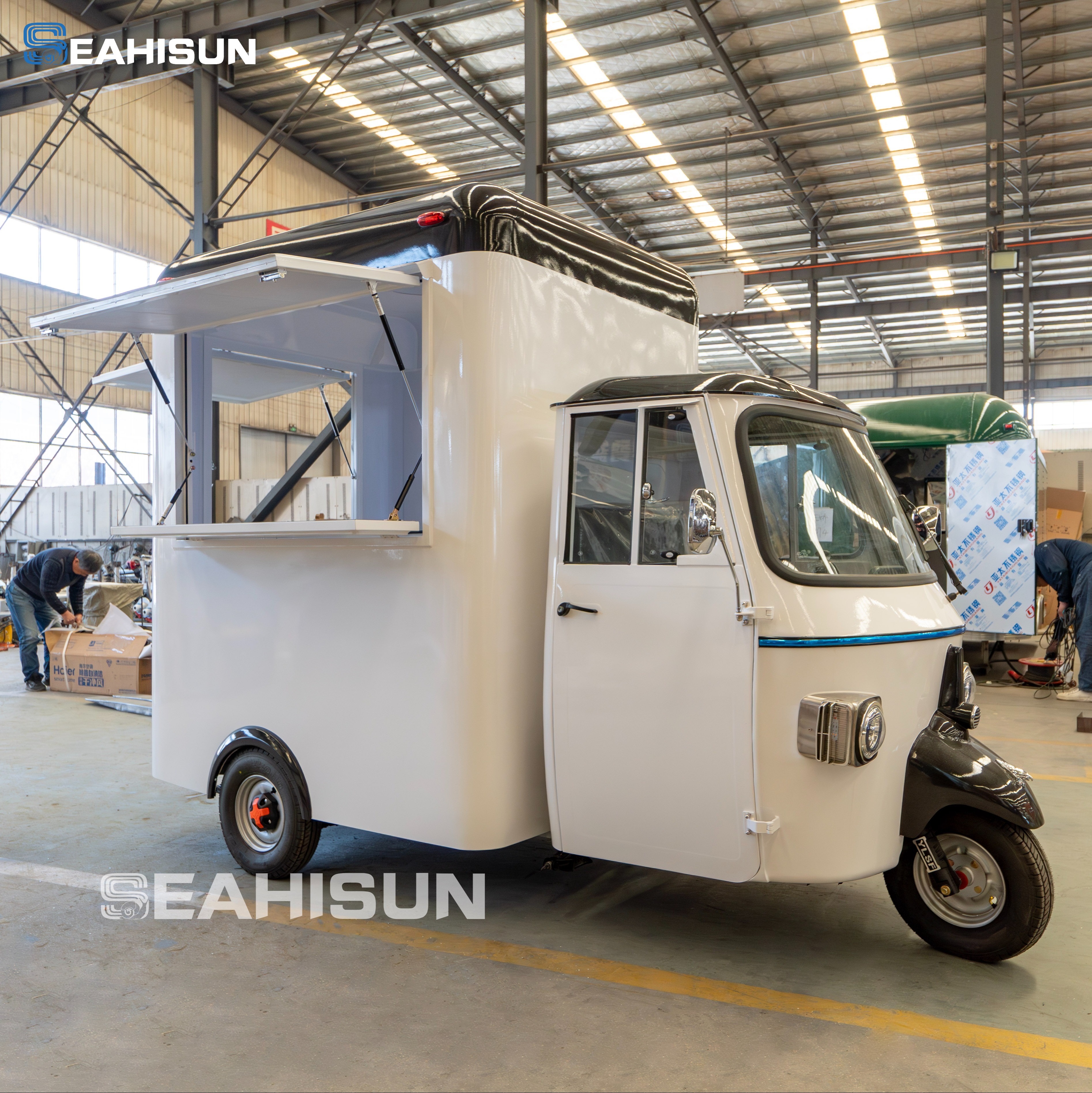
Technical Specifications to Vet Before Purchasing an Electric Vending Cart
Never buy a commercial cart based solely on aesthetics. A beautiful exterior means nothing if the motor fails on a hill. You must thoroughly verify the technical foundation of your electric vending cart. Minor oversight here causes catastrophic operational failures later.
Here are the critical technical specifications to evaluate before purchasing:
- Drivetrain vs. Appliance Power: Commercial buyers must insist on isolated battery systems. You need a dedicated 48V system purely for mobility. You then need a separate, high-capacity lithium or AGM (Absorbent Glass Mat) battery bank. This secondary bank powers your equipment exclusively. Mixing them risks draining your drive motor. You could become stranded mid-route.
- Payload Capacity & Frame Integrity: Calculate the combined weight carefully. Add your commercial equipment, full water tanks, heavy inventory, and operators. This massive payload heavily impacts the structural integrity of the chassis. Aluminum frames save weight but may flex under severe stress. Reinforced steel frames offer superior durability for heavy liquid payloads.
- Range and Motor Torque: Evaluate mid-drive motors versus hub motors. Mid-drive motors utilize the bike's internal gearing. They offer superior torque for pulling heavy loads from a dead stop. Set realistic range expectations early. A fully loaded trike typically achieves 20 to 30 miles per charge. Incline gradients severely reduce this range. Steep hills drain batteries exceptionally fast.
- Braking Systems: Stopping a 600-pound loaded trike is incredibly dangerous. Mechanical brakes stretch and fail under this immense pressure. You must demand hydraulic disc brakes. Hydraulic fluid provides immediate, powerful stopping force. It ensures operator safety in crowded pedestrian zones.
Compliance, Health Codes, and Street Legality
Municipal regulations strictly dictate your final design. You cannot operate legally without passing rigorous local health inspections. Do not build the cart before speaking directly to local inspectors. Their word is final.
Health department prerequisites are incredibly strict across the country. You must design the compact footprint efficiently. Many jurisdictions mandate three-compartment sinks for washing utensils. They strictly require completely separate handwashing stations. You must calculate adequate capacities for fresh water and gray water tanks. Fitting all these complex plumbing requirements into a small tricycle frame takes precise engineering.
Materials and sanitation standards matter deeply to inspectors. They look closely at your work surfaces. Ensure all food-contact zones use appropriate materials. Countertops must feature food-grade stainless steel. Alternatively, use NSF-certified non-porous materials. Wood and porous plastics will fail inspection instantly. They harbor dangerous bacteria.
Street legality presents another bureaucratic hurdle. You must navigate local Department of Transportation classifications carefully. Ask authorities when an e-trike classifies as a bicycle versus a motorized vehicle. This legal classification dictates your insurance needs. It determines exactly where you can ride. Speed limit caps usually apply. Most cities restrict commercial trikes to under 15 or 20 mph. They prioritize pedestrian safety over transit speed.
Sourcing Strategy: How to Shortlist Manufacturers
Finding a reliable manufacturing partner is your final major hurdle. Poor manufacturing quality destroys your business before it even starts. You cannot afford chassis cracks or electrical fires. Use a strict vetting process to evaluate overseas and domestic vendors.
- Demand Customization Transparency: Avoid vendors refusing to provide detailed CAD drawings. You need precise dimension layouts prior to manufacturing. You must verify equipment clearances visually. You need exact sink dimensions to show health inspectors. If they will not share blueprints, walk away immediately. Transparency is non-negotiable.
- Evaluate Component Availability: Assess the mechanical parts the manufacturer uses. Do they use proprietary motors and controllers? This spells complete disaster. If a proprietary part breaks, you wait weeks for international shipping. Demand standard, universally replaceable e-bike components. You can buy these at local bike shops. This strategy crucially minimizes your operational downtime.
- Scrutinize Warranty and After-Sales Support: Read the fine print carefully. Demand absolute clarity on warranty splits. Often, manufacturers cover the steel frame for five years. They might only cover the lithium battery for one year. Determine the availability of localized repair networks. You need to know exactly who will fix the motor when it fails on a busy Saturday morning.
Conclusion
Launching a profitable mobile culinary business requires methodical, patient planning. You must define your highly targeted menu first. Use that specific menu to calculate your exact power and storage needs. Only then should you select your chassis and isolated battery system. This sequential evaluation strongly prevents costly engineering mistakes. The electric platform significantly lowers your initial barrier to entry. It provides unmatched access to lucrative, high-traffic pedestrian zones. Your immediate next step is simple but vital. Contact your local health department today. Request their specific mobile vending regulations and plumbing requirements. Have them explain their sink rules thoroughly. Do this before putting down any financial deposit on a custom build.
FAQ
Q: How long does the battery last on an electric tricycle food truck?
A: You must separate driving range from appliance runtime. The driving range typically covers 20 to 40 miles. This distance depends heavily on your payload and route gradients. Appliance runtime varies wildly based on wattage. A refrigerator might run for 12 hours on a secondary battery bank. An espresso machine might drain it in two hours without shore power.
Q: Do I need a special driver’s license to operate an electric vending cart?
A: In most jurisdictions, authorities classify these carts as e-bikes. They do not require a commercial driver's license (CDL). You usually only need a standard driver’s license or no license at all. However, strict local speed limits and motor wattage caps apply. Always check your local Department of Transportation rules.
Q: Can a compact food truck operate in the rain or winter weather?
A: Operating in harsh weather presents significant challenges. The operator cabins often remain exposed. You must ensure the manufacturer uses marine-grade wiring and sealed battery compartments to prevent short circuits. You will also need seasonal operational strategies, such as adding heavy-duty vinyl enclosures and anti-slip tires for winter conditions.
Q: Is it possible to cook raw food on a tricycle food truck?
A: It is extremely difficult to meet health codes for raw food prep on a trike. Cooking raw meat requires exhaust hoods, fire suppression, and massive water tanks. Trikes simply lack the space and payload capacity. We strongly recommend serving pre-packaged goods or commissary-prepared menus to simplify your operations.
 注: 建议图片大小150px*50px


