 注: 建议图片大小150px*50px

丨
注: 建议图片大小150px*50px


Views: 0 Author: Site Editor Publish Time: 2026-07-04 Origin: Site


The long-term viability of a mobile catering business relies heavily on its foundation: the trailer chassis. Choosing the wrong axle configuration leads to either dangerous overloading or wasted capital. Buyers often evaluate aesthetics and interior layout first. They neglect how commercial kitchen equipment weight impacts towing safety, compliance, and daily operations. Ignoring this underlying structure invites massive risk. A poorly matched foundation can destroy expensive cooking equipment or cause severe highway accidents.
We provide an evidence-based framework to help operators decide between a single-axle and a dual-axle food trailer based on menu requirements and route logistics. You will learn to evaluate options critically. You will understand how payload capacity dictates your entire business model. This guide ensures your next mobile kitchen matches your exact operational needs.
The chassis serves a much greater purpose than mere mobility. It acts as the backbone of your entire business. This steel framework dictates structural integrity under extreme stress. Commercial kitchen equipment is exceptionally heavy. Furthermore, it vibrates constantly during operation. Generators hum, refrigerators cycle, and road travel shakes the entire structure. A high-quality mobile kitchen chassis must absorb these kinetic forces. If the frame flexes too much, your interior walls will crack. Your gas lines could detach. Your business operations will halt.
Operators frequently misunderstand the weight equation. Your payload capacity disappears much faster than you expect. Consider your plumbing system first. Water weighs 8.3 pounds per gallon. A standard 40-gallon fresh water tank adds 332 pounds. A 45-gallon grey water tank adds another 373 pounds. Then you add commercial generators, which easily exceed 250 pounds. Commercial refrigeration units, flat-top grills, and exhaust hoods consume the remaining capacity rapidly. You must calculate every single ounce.
Compliance forms your operational baseline. Local Department of Transportation (DOT) agencies monitor commercial trailers aggressively. Highway patrols enforce strict weight limits based on your axle ratings. Overweight trailers face heavy penalties. Officers can impound your rig immediately. Accurate weight estimation becomes the mandatory first step in evaluation. Never guess your equipment load. Always rely on hard manufacturer data to stay legal and safe.
Single-axle units fill a highly specific niche in the catering industry. They present the ideal target profile for lightweight menus. Coffee carts, shaved ice stands, and pre-packaged food vendors thrive using these platforms. They excel in short-distance, local towing scenarios. You rarely see them crossing state lines. Instead, they navigate local neighborhoods and nearby festivals efficiently.
Maneuverability remains their strongest core advantage. They back up easily. You can often pivot them by hand using a simple jockey wheel. This agility proves invaluable in tight spaces. Dense farmer's market stalls become easily accessible. Narrow residential driveways pose no problem. You spend less time parking and more time serving customers. Furthermore, they demand a lower initial purchase price. You only buy two tires. You maintain half the braking components. This simplicity appeals to many first-time operators.
However, you must understand their critical limitations. Single-axle units are highly susceptible to overloading. A small menu expansion can push you past the legal weight limit. Moreover, a tire blowout on a single axle constitutes a critical emergency. The entire side of the trailer instantly drops. This immediately destabilizes the towable food trailer. You risk a severe rollover event at highway speeds. You must monitor tire pressure obsessively to mitigate this risk.
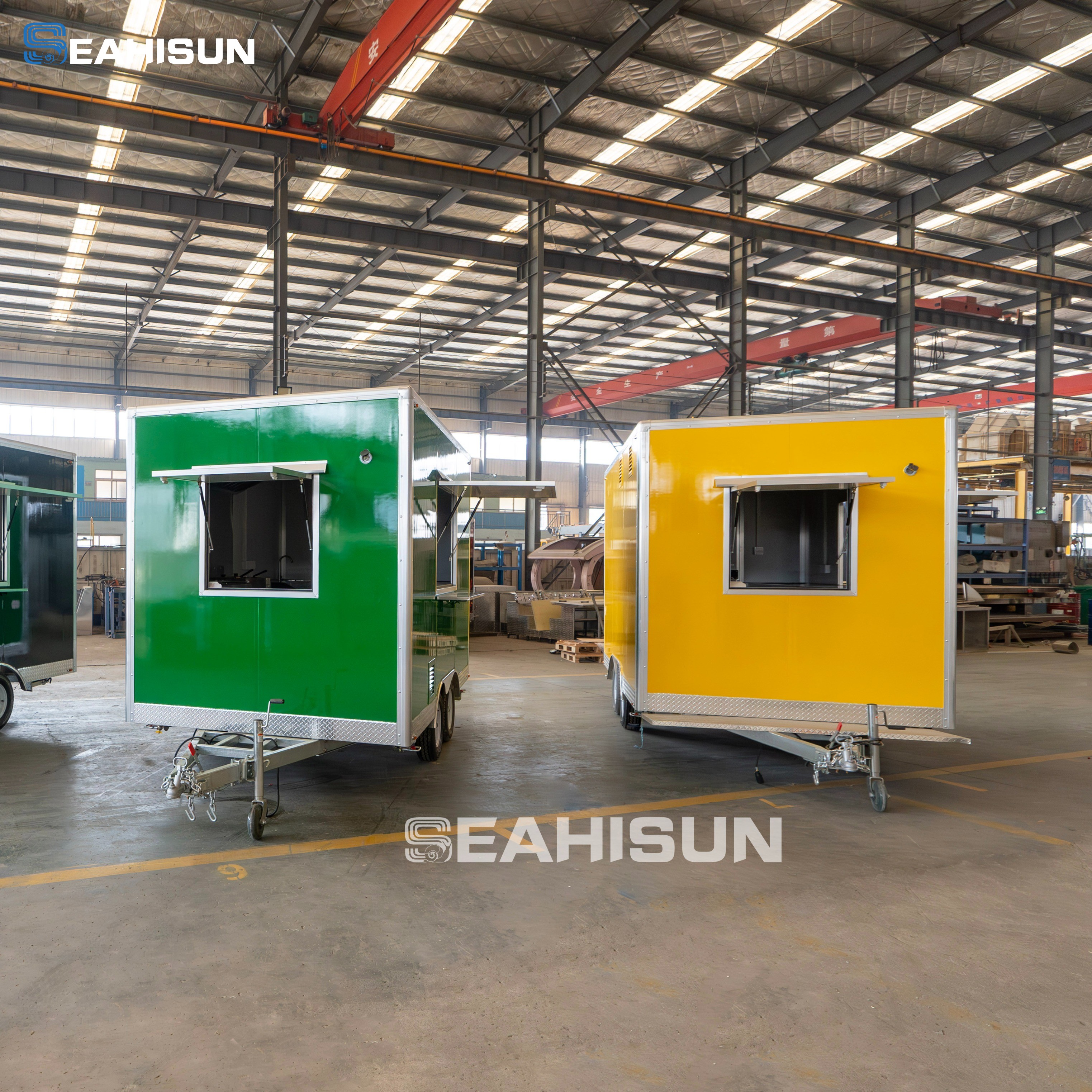
Heavy-duty operations require a robust foundation. These trailers target full-scale mobile kitchens. They carry heavy BBQ smokers effortlessly. They support high-volume catering operations requiring massive prep areas. If you plan frequent highway travel, this configuration becomes mandatory. The robust engineering handles extreme daily wear and tear.
Superior weight distribution defines their core advantage. Two axles disperse heavy equipment loads evenly across the frame. This prevents the steel from warping over time. Redundancy equals safety in the mobile food business. This configuration acts as a naturally stable towing trailer. If one tire blows out, you do not face a catastrophic drop. The second tire on that side provides enough support to maintain control. You can safely decelerate and pull over onto the shoulder.
You also experience significantly smoother towing. The secondary axle reduces bouncing and swaying at highway speeds. This smooth ride protects your fragile interior equipment. Deep fryers will not spill residual oil easily. Glass-front refrigeration units avoid shattering. Equipment longevity increases dramatically. As a terminology note, builders often refer to these interchangeably as tandem-axle units. Many in the industry also call them a dual-wheel trailer. Technically, "dual-wheel" refers to dually pickup trucks. However, the shorthand remains widely used on sales floors.
You must evaluate your three-year menu plan before purchasing. Do not buy a trailer just for today. Think about your future goals. Is there a chance you might add heavy equipment later? You might want larger griddles. You might need extra deep fryers. High-volume events demand more fresh water capacity. Single-axles lock you into your current lightweight setup. Dual-axles provide the necessary scale. They allow you to grow your kitchen without replacing the entire unit.
Your daily driving environment dictates your required maneuverability. Urban spaces contrast sharply with open highways. Single axles win consistently in dense urban settings. They navigate sharp city corners easily. Conversely, dual-axles dominate cross-county catering gigs. They handle high-wind environments beautifully. Heavy crosswinds push single-axle units around aggressively. A heavier footprint keeps you firmly planted in your lane during interstate travel.
First-time buyers often make a costly mistake regarding their tow vehicle. They purchase a massive dual-axle trailer blindly. Then they realize their current SUV lacks the towing capacity. Their half-ton truck cannot pull the loaded unit safely. This forces an unexpected, highly expensive truck upgrade. You must highlight this risk in your budget. Always verify your vehicle limits first. Your trailer choice must strictly align with your tow vehicle’s capabilities.
| Evaluation Criteria | Single-Axle Chassis | Dual-Axle Chassis |
|---|---|---|
| Payload Capacity | Low (Max ~3,500 - 5,000 lbs) | High (7,000 - 14,000+ lbs) |
| Manual Maneuverability | Excellent (Pivotable by hand) | Poor (Requires tow vehicle) |
| Highway Stability | Fair (Susceptible to crosswinds) | Excellent (Superior tracking) |
| Blowout Safety Risk | High (Immediate destabilization) | Low (Redundant tire support) |
| Equipment Scalability | Restricted (Locked to light menu) | Flexible (Room for heavy upgrades) |
The "Dry Weight" trap ruins many business plans. Dealerships often list the manufacturer's empty weight on the sticker. They use this low number to sell units quickly. Never use this empty weight for your towing calculations. It represents an impossible operational scenario. Always calculate your requirements based on fully loaded weight. You must include full wet tanks, cooking oil, propane cylinders, and heavy food inventory. These items frequently add over a thousand pounds to the scale.
Maintenance realities surprise new operators. A heavy-duty setup means maintaining twice the running gear. You must replace four tires instead of two. You must pack and grease four sets of wheel bearings annually. Dual braking systems require regular inspection and adjustment. Your operational budget must reflect these non-negotiable maintenance tasks. Neglecting trailer brakes leads to severe rear-end collisions.
License and insurance variances also create hidden hurdles. Upgrading to a heavy-duty chassis increases your combined vehicle weight. You might unknowingly cross strict regulatory thresholds. Pushing your combined weight over 26,000 pounds potentially requires a commercial driver's license (CDL). This varies by state. Furthermore, higher weight classes trigger higher insurance premiums. Commercial policies price risk based on mass and braking distance. You must consult your insurance agent before finalizing any trailer purchase.
We developed a clear shortlisting logic to guide your decision. You must honestly assess your daily operational realities. Avoid buying more trailers than you need. Likewise, never buy less capacity than safety demands.
Your next-step action is critical. Consult with a custom builder directly. Map your specific equipment list to an accurate weight projection. Do this before selecting the chassis. Let the math dictate the foundation.
The choice between a single and dual-axle isn't about which is objectively "better." It is entirely about which safely and legally supports your specific business model. Lightweight carts thrive on single axles. Heavy commercial kitchens demand dual axles. You must align your mechanical foundation with your culinary ambitions.
We urge you to prioritize safety over initial savings. Do not compromise on chassis capacity to save money upfront. Structural failure will destroy your equipment and halt your revenue stream entirely. DOT fines will easily eclipse any initial savings you thought you gained. Protect your investment by building on the right platform from day one.
Contact our fabrication team today for a comprehensive payload consultation. We will match your exact catering menu to the correct trailer foundation. Let us engineer a mobile kitchen that keeps you profitable, legal, and safe on the road.
A: Single axles typically max out around 3,500 to 5,000 lbs Gross Vehicle Weight Rating (GVWR). Dual axles easily handle 7,000 to 14,000+ lbs. The exact capacity depends entirely on the specific axle ratings, suspension type, and main frame steel thickness.
A: Manual positioning is extremely difficult. While single axles can often be pivoted by hand with a jockey wheel, dual axles resist tight turns. Their tires scrub against the pavement. You generally need a tow vehicle or a motorized dolly to position them accurately.
A: It depends heavily on your total loaded weight. However, heavy setups generally require at least a half-ton or three-quarter-ton truck. Your vehicle must also feature an integrated or aftermarket electronic brake controller to operate the trailer brakes safely.
A: Yes, they offer superior safety at high speeds. They provide excellent tracking, significantly reduce sway, and handle crosswinds better. Most importantly, they offer critical redundancy. If one tire blows out, the second tire keeps the trailer stable until you pull over.

