Mobile culinary vendors are rapidly shifting away from bulky step-vans. Many operators now favor highly efficient, compact mobile vending solutions. You likely want to access high-traffic, restricted areas like hotel lobbies, private courtyards, and narrow pedestrian zones. Standard food trucks simply cannot fit into these premium spaces.
This is where the classic three-wheeled vehicle shines. It offers a distinct commercial advantage. You get a stunning vintage aesthetic combined with a micro-footprint. This footprint easily secures placement in exclusive venues. People love to photograph these vehicles, organically boosting your brand visibility.
This guide provides a concrete evaluation framework. You will learn how to source, customize, and deploy a compact vending vehicle properly. We explore essential payload limits, complex compliance traps, and equipment integration strategies. You will discover exactly how to engineer these micro-spaces for your specific menu concept.
Key Takeaways
- The Piaggio Ape chassis offers a 30-40% smaller footprint than traditional trailers, maximizing venue accessibility while requiring strict payload management.
- Electric conversion options (electric 3-wheels) are now industry-standard for indoor events, though battery capacity dictates equipment limitations.
- Health department compliance and street-legality (DOT/EPA regulations in the US) vary drastically based on the build origin and gross vehicle weight.
- Procurement requires vetting builders on their ability to integrate commercial-grade equipment without compromising the vehicle's center of gravity.
Why Invest in a Piaggio Ape Food Cart?
The primary appeal of a Piaggio Ape food cart lies in its unparalleled micro-mobility. Standard step-vans require massive parking spots. They often disrupt pedestrian flow. Conversely, a compact three-wheeler easily glides through double doors. You can park it inside convention centers or rooftop gardens. It demands barely a fraction of the square footage required by a traditional trailer.
This agility directly translates into premium location access. Operating a tuk tuk food cart allows you to target corporate campus courtyards and upscale hotel lobbies. These locations typically ban full-sized commercial vehicles. You gain a captive audience.
Beyond mobility, consider the profound impact on brand perception. The European vintage design acts as a powerful, natural marketing asset. Consumers intuitively perceive the setup as artisanal and premium. This aesthetic encourages organic social media sharing. Guests will photograph your setup. This perceived value directly increases your premium pricing power for the actual products sold.
Finally, these vehicles offer a significantly lower barrier to entry. You avoid the crushing overhead of a full-scale mobile kitchen. Commercial parking fees drop dramatically. Insurance policies often cost less. You also consume far less fuel or electricity during transit.
Custom Configurations: Engineering for Specific Menus
The Ape Coffee Cart
Transforming a micro-chassis into a functional Ape coffee cart requires obsessive space mapping. You must integrate a commercial dual-group espresso machine. You also need space for commercial grinders, knock boxes, and pitcher rinsers. Heavy espresso machines must sit directly above the rear axle. This prevents dangerous weight imbalances.
Power and plumbing present the largest hurdles. Espresso machines draw massive electrical loads. You often need 220V systems handling 30 to 50 amps. Heating elements drain batteries quickly. Additionally, you must install reliable water pumps. Dual fresh and gray water tanks must meet local health codes. Operators typically mount these tanks low in the chassis to maintain a safe center of gravity.
The Mobile Bar: Beer and Juice
Beverage service demands entirely different engineering. Draft systems require secure keg mounting. A full half-barrel keg weighs over 160 pounds. You must distribute this liquid volume carefully to avoid suspension failure. Routing CO2 lines safely through tight enclosures is mandatory.
Temperature control poses another challenge. High-volume service quickly depletes standard refrigeration. Flash-chilling systems work best here. They cool room-temperature beer instantly as it flows through the lines. This eliminates the need to refrigerate bulky kegs, saving precious payload capacity.
The Electric Ice Cream Cart
Designing an electric ice cream cart means prioritizing cold storage autonomy. Traditional freezers require constant, high-draw electricity. Instead, expert builders integrate cold-plate freezers. You plug these units into shore power overnight. The internal plates freeze solid. They then maintain safe freezing temperatures for 8 to 12 hours independently.
If you choose active refrigeration, you must evaluate battery bank requirements. Lithium-ion setups offer the best power-to-weight ratio. You need extensive calculations to ensure the battery bank survives an entire 8-hour summer event.
The Taco Food Cart & Hot Food Prep
Hot food preparation introduces critical safety variables. Building a taco food cart means handling open flames or high-draw electric griddles. Ventilation becomes your main obstacle. Installing a Type 1 commercial hood and fire suppression system inside a micro-space takes brilliant engineering.
Cooking equipment requires external propane tank mounting. You cannot legally store propane inside the enclosed cabin. Furthermore, flat-top griddles generate intense radiant heat. You must deploy advanced heat dissipation strategies. Stainless steel heat shields protect the vehicle shell and the operator.
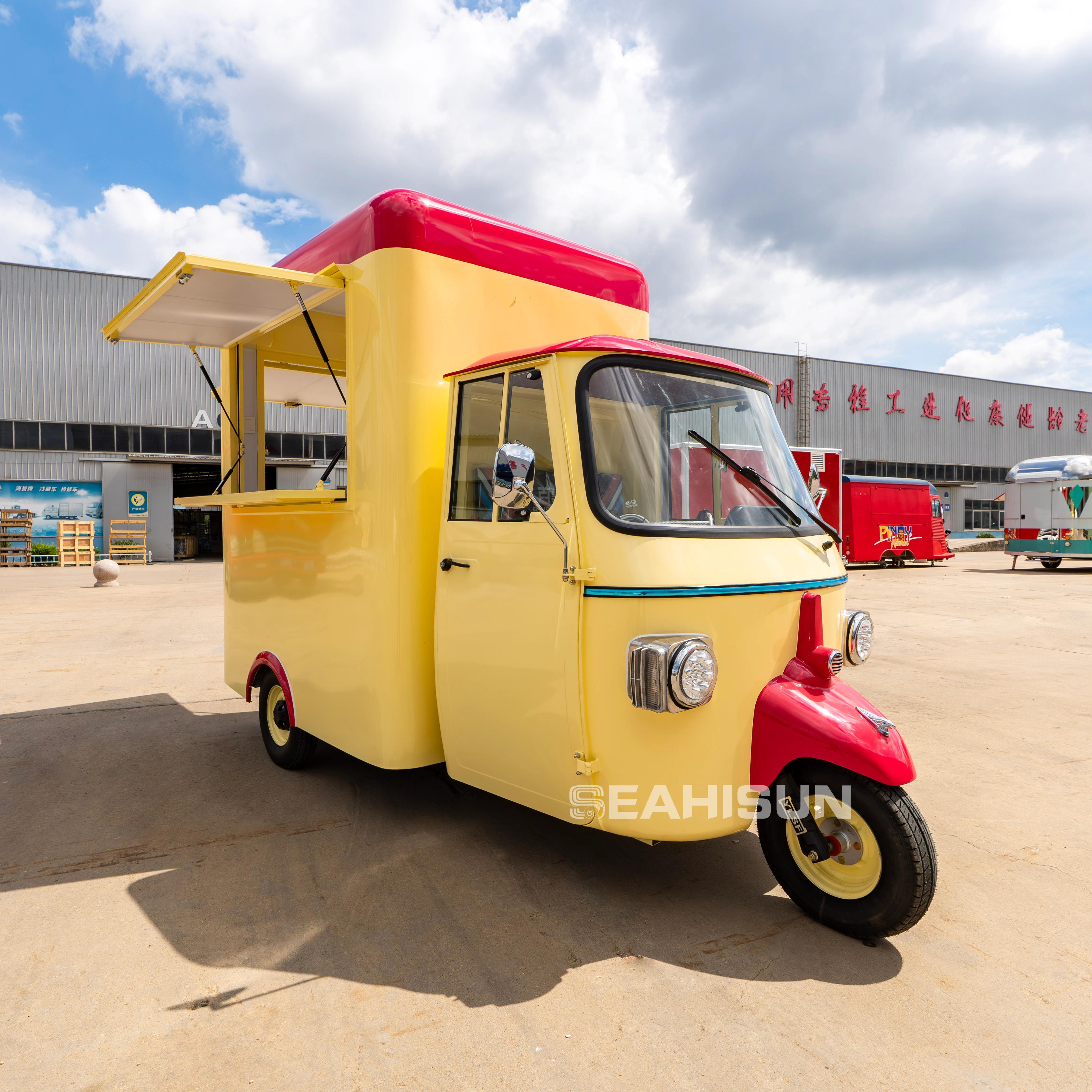
Evaluating a Custom Mobile Cart: Core Specifications
Sourcing a reliable custom mobile cart involves evaluating rigid structural specifications. You cannot afford to guess on mechanical tolerances.
Chassis selection is your first major decision. You generally have three options: authentic vintage frames, modern production models, and overseas replicas. Authentic vintage frames possess incredible charm but often suffer from metal fatigue. Modern models offer robust structural integrity. Replicas provide cost savings but require intense scrutiny regarding weld quality.
Powertrain Evaluation Chart
| Powertrain Type | Best Use Case | Emissions | Maintenance Needs |
| Gasoline Engine | Outdoor street vending, hilly terrain | High (Often restricts indoor use) | Frequent (Oil, belts, filters) |
| Electric Conversion | Indoor events, malls, zero-emission zones | Zero | Low (Battery health monitoring) |
Payload capacity remains the most critical metric. Builders must calculate the Gross Vehicle Weight Rating (GVWR) accurately. A standard chassis might only support 1,100 pounds. Equipment, operators, and full water tanks add up fast. Thirty gallons of water alone weighs 250 pounds. Poor weight distribution leads to suspension failure. Worse, it creates severe tipping risks.
Build materials also dictate longevity. Always demand 304 commercial-grade stainless steel for all food zones. It resists corrosion and satisfies health inspectors. For the exterior shell, fiberglass offers excellent weight savings. However, aluminum structures provide superior durability against daily road vibrations.
Navigating Compliance, Street Legality, and Operational Risks
Many novice operators purchase a vehicle only to discover they cannot legally use it. You must navigate a maze of local regulations.
Street legality across US and EU markets limits three-wheelers. Most jurisdictions classify them as Low-Speed Vehicles (LSVs). They typically face a 25 mph speed restriction. You cannot drive them on highways. Importing vintage frames into the US requires strict DOT and EPA compliance. Often, operators choose to tow the vehicle on a flatbed trailer to bypass complex street-legal registration issues.
Health department codes demand rigorous planning. To pass inspection, you must squeeze a massive amount of compliance gear into a tiny space. Follow this numbered list to ensure compliance:
- Sink Integration: Install a mandatory three-compartment sink for dishwashing.
- Hand Hygiene: Include a separate, dedicated handwashing sink with splash guards.
- Water Heating: Mount a commercial-grade water heater capable of sustaining 120°F temperatures.
- Contamination Protection: Fabricate custom sneeze guards to enclose all food preparation areas.
Finally, acknowledge your operational bottlenecks. These vehicles possess almost zero dry storage space. You cannot store extra cups, backup ingredients, or reserve ice. High-volume events require a robust logistical plan. You absolutely need a permitted commissary kitchen for prep work. Most operators also deploy a secondary support vehicle for mid-event restocking.
How to Shortlist Builders and Source Your Cart
Choosing the right manufacturing partner determines your ultimate success. The market splits between domestic retrofitters and overseas importers. B2B platforms like Alibaba offer tempting cost savings. However, these platforms rarely guarantee local health code compliance. Local specialized builders charge a premium. In exchange, they provide rigorous quality control, local warranties, and guaranteed inspection passage.
Vetting builder expertise is mandatory. Treat the initial consultation like an interview. Look for builders who understand commercial kitchen physics.
- Ask them to produce a 3D space-mapping layout of your equipment.
- Demand to see their weight distribution modeling and GVWR calculations.
- Request detailed electrical load schematics to prove they understand amperage draws.
- Clarify exact warranty terms on both the chassis and the custom fabrications.
Understand realistic project phasing. Custom builds do not happen overnight. Procuring a reliable chassis often takes four weeks. The 3D modeling and approval phase takes another two weeks. Physical fabrication, equipment mounting, and plumbing easily consume eight to twelve weeks. Finally, scheduling and passing the health inspection can delay launch by another two weeks. Plan your business launch accordingly.
Conclusion
Deploying a compact, three-wheeled mobile kitchen offers unmatched access to lucrative venues. Success requires meticulously matching your menu concept to the strict power and payload limits of the micro-chassis. Do not force heavy, high-draw equipment into a shell incapable of supporting it.
Always start your journey at the local health department. Secure a copy of their specific mobile food facility requirements before making any deposit. Regulations vary wildly between counties. What passes in one city might fail immediately in the next.
Your clear next step is scheduling a consultation with a certified custom fabricator. Bring your finalized menu and exact equipment list. Request a preliminary space-mapping layout and a payload calculation. This data-driven approach ensures your aesthetic investment translates into a highly profitable, legal operation.
FAQ
Q: How much does a fully equipped Piaggio Ape food cart cost?
A: Costs vary drastically. A bare, unequipped chassis typically ranges from $6,000 to $12,000. A fully customized commercial kitchen buildout, including plumbing, electrical panels, and professional-grade appliances, pushes the total cost between $25,000 and $55,000. Electric powertrain conversions represent the higher end of this spectrum.
Q: Are Piaggio Ape carts street legal in the US?
A: They are heavily restricted. Most qualify as Low-Speed Vehicles (LSVs) limited to roads with speed limits under 35 mph. They cannot travel on highways. Many operators avoid complex DOT registrations by transporting the cart on a flatbed trailer directly to the event location.
Q: Can an Ape coffee cart run entirely on batteries?
A: Yes, but it requires a massive lithium-ion battery bank and a high-capacity inverter. Commercial espresso machines draw 3,000 to 6,000 watts. Running this entirely off-grid for eight hours is expensive and heavy. Most operators rely on venue shore power or silent inverter generators instead.
Q: Do I need a commercial driver’s license (CDL) to drive a tuk tuk food cart?
A: No. Because these vehicles possess a Gross Vehicle Weight Rating (GVWR) far below the 26,001-pound federal threshold, a standard driver's license suffices. However, always verify specific motorcycle or three-wheel endorsements required by your local state Department of Motor Vehicles.
 注: 建议图片大小150px*50px


