

Views: 0 Author: Site Editor Publish Time: 2026-06-25 Origin: Site


Operating a coffee business on wheels often sounds highly romantic to new entrepreneurs. However, daily profitability strictly depends on your speed of service and equipment reliability in a mobile setting. A poorly designed workflow quickly creates severe bottlenecks during those critical peak morning rushes. Furthermore, the technical stakes remain incredibly high when taking heavy commercial equipment on the road. Standard espresso machines require precise power loads, specific water pressure, and rigid physical mounting. They must survive harsh daily transit without suffering catastrophic internal failures.
This guide provides a comprehensive, decision-stage blueprint for outfitting a coffee machine food trailer. You will explore practical ways to manage strict utility constraints and maximize your spatial efficiency. We also outline how to guarantee local health code compliance from day one. By the end, you will understand exactly how to turn a cramped mobile footprint into a high-output profit engine.
You must define operational success by your "cups per hour" (CPH) metric during peak periods. Operators cannot afford to guess their output capacity. Every physical customization inside your vehicle must support sustained high-volume output. If an interior feature does not increase your CPH, you should reconsider its placement.
You will face intense physical constraints when designing the workspace. A standard 10ft to 12ft trailer presents a highly restrictive footprint. You must comfortably house over 200 pounds of countertop equipment. Add bulky under-counter refrigeration units and a fresh water tank. Now place two operators inside this exact same footprint. Poor spatial planning causes daily cross-traffic collisions between your baristas. These collisions destroy output speed and create operator fatigue.
Consider the massive ROI impact of ergonomic design. A streamlined mobile coffee shop completely eliminates wasted physical movement. Imagine reducing a barista's motion by just two steps per drink. If you serve 150 drinks during a morning rush, you save 300 steps. This translates directly to faster service times. You capture significantly more sales at busy outdoor events. Customers stay in line when they see a fast-moving queue. Efficient workflows scale your daily revenue capacity.
Powering heavy equipment demands serious technical planning. Commercial machines dictate strict electrical rules. You must understand the difference between 110V and 220V systems. A 110V unit draws fewer amps but heats up much slower. Conversely, a 220V machine recovers fast during heavy rushes. However, 220V units require a much more robust generator setup.
You must also calculate starting watts versus running watts. Dual boilers heating simultaneously create massive initial power spikes. Your power source must handle this surge safely.
Generator sizing matters deeply for any espresso trailer. You must purchase a pure sine wave inverter generator. Standard industrial generators produce "dirty" power with high harmonic distortion. This power fluctuation quickly destroys sensitive internal computer boards on modern equipment. Inverter units prevent these catastrophic electrical surges.
| Electrical System | Heating Recovery Speed | Power Draw Profile | Best Use Case |
|---|---|---|---|
| 110V Machine | Slower (Single boiler or heat exchange) | 15A to 20A (Standard NEMA plug) | Low-to-medium volume pop-ups |
| 220V Machine | Rapid (Dedicated dual boilers) | 30A to 50A (Heavy-duty NEMA plug) | High-volume festivals and daily routes |
Water systems remain equally critical to your success. High-volume workflows demand direct plumbing. You simply cannot rely on internal reservoir machines. Manually refilling small water tanks slows down your service tremendously. Sizing your water pump correctly prevents equipment damage. You need an accumulator tank installed inline. This device maintains a consistent 9 bars of line pressure. It ensures the espresso machine's internal rotary pump never starves during extraction.
Water filtration realities often shock new owners. Mineral scale buildup is the leading cause of mobile machine failure. You must install inline reverse osmosis (RO) systems or robust ion-exchange filters. These units protect your expensive investment from hard municipal water supplies.
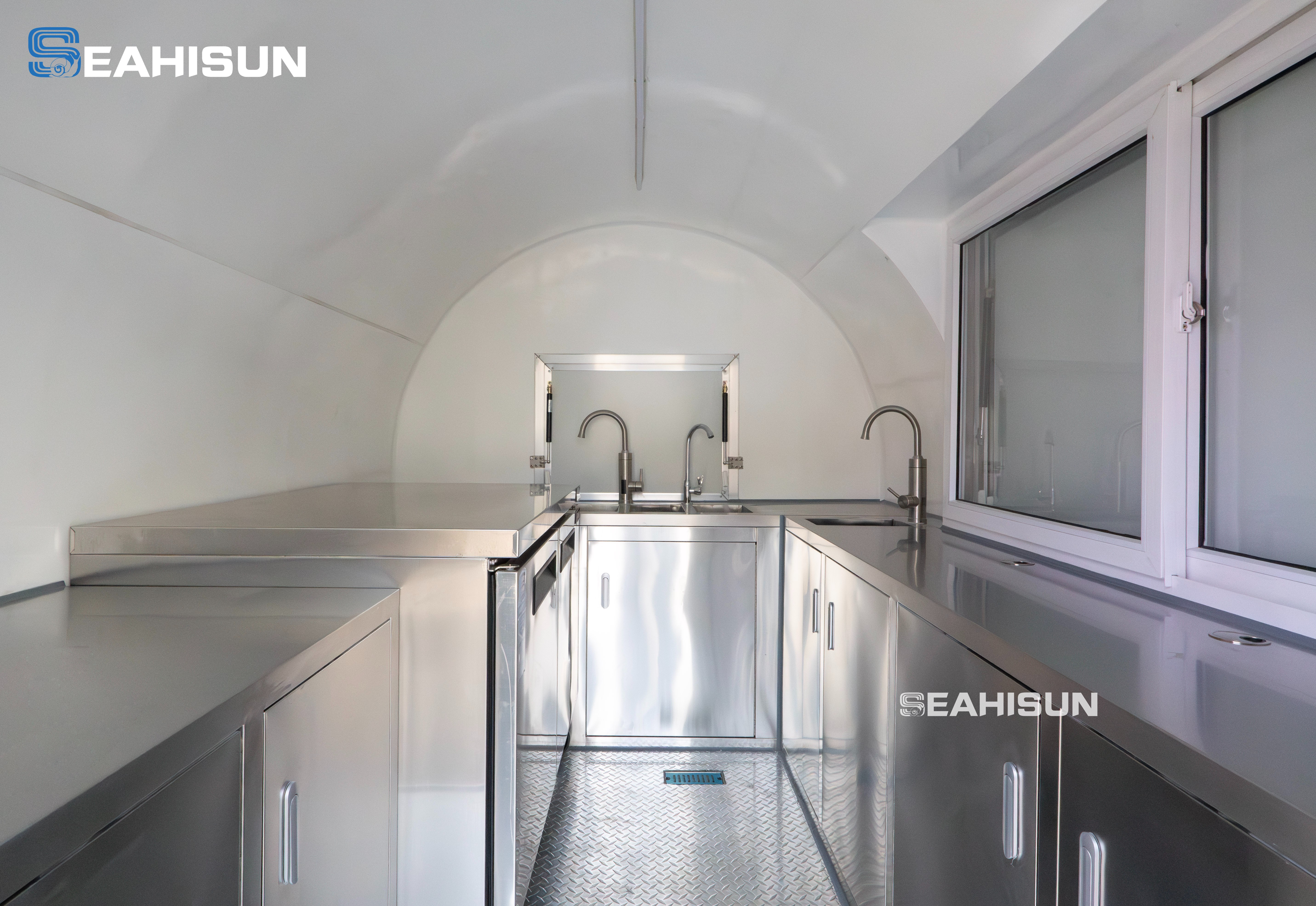
An optimal coffee trailer layout relies heavily on the "barista triangle." You must position the commercial grinder, espresso machine, and knock box very closely together. They must exist within a zero-step pivot radius. The operator should simply shift their weight to perform these core actions. Reaching across aisles ruins efficiency.
You should place milk fridges directly beneath this primary workstation. Under-counter refrigeration minimizes constant bending. It also drastically reduces milk heat exposure during busy periods. Drawer-style fridges often work better here than traditional swinging doors.
Service window alignment dictates your ultimate speed. You need a strict linear progression. The interior layout must follow a logical physical sequence. Ensure you arrange workstations in this specific order:
This continuous line ensures the barista never turns their back to the waiting queue. The drinks flow seamlessly from left to right, or right to left.
Road-readiness introduces unique bolting constraints. Securing a 150-pound dual-boiler machine is not optional. You must bolt it directly through reinforced stainless countertops. Always place heavy equipment directly over the trailer axles. This specific placement balances the load perfectly. It ensures safe towing weight distribution on the highway.
Passing strict health inspections requires careful plumbing design. The standard 3-compartment rule applies almost everywhere across the country. You need dedicated wash, rinse, and sanitize sinks. You must also install a separate handwashing sink equipped with specialized splash guards. A fully compliant water sink food trailer dedicates significant interior real estate solely to this mandatory setup.
High-volume baristas rely heavily on pitcher rinsers. You should integrate recessed pitcher rinsers directly into your stainless drainboards. Note an important compliance detail here. Many health departments strictly require backflow preventers on rinser water lines. These vacuum breakers stop contaminated gray water from accidentally entering your fresh supply.
Tank ratios dictate your daily operating limits. You must follow the standard compliance rule for water storage. The gray water (wastewater) tank must be 15% to 50% larger than your fresh water tank. This critical buffer prevents catastrophic overflows when washing dishes heavily.
Inspectors closely check your working surfaces. Select NSF-approved, non-porous 304-grade stainless steel for all machine countertops. Wood or cheap laminate holds dangerous bacteria over time. Avoid these common health department failures:
You must match the physical vehicle strictly to your primary venue type. Operating via street parking differs vastly from serving at indoor pop-ups. Multi-day music festivals require entirely different logistics than small corporate lobbies.
The coffee vending cart offers a compelling business case. It requires significantly lower initial capital. Towing and storage remain incredibly easy. Carts are ideal for corporate catering or quick indoor events. They fit neatly through standard double doors. However, they carry significant daily trade-offs. You face extremely limited fresh water capacity. You also rely completely on venue power to operate your equipment.
The full custom trailer unlocks maximum CPH potential. It provides completely self-contained, off-grid capabilities. A larger unit easily houses a two-person team comfortably. It shields your staff from severe weather. The trade-offs include needing a heavy-duty tow vehicle. You also face tougher footprint permits at public street events.
| Feature | Vending Cart | Full Trailer |
|---|---|---|
| Initial Investment | Lower barrier to entry | Higher capital requirement |
| Mobility | Fits through standard doors | Requires a capable tow vehicle |
| Water/Power | Relies mostly on venue utilities | Fully off-grid capable via generator |
| Staff Capacity | 1 Solo Operator | 2 to 3 Operators comfortably |
Your next steps require detailed local research. Always audit your local county health department requirements thoroughly. Do this before committing any financial deposit to a custom trailer fabricator. Regulations vary wildly between neighboring counties.
A successful mobile coffee business is built logically from the espresso machine outward. You must plan your utilities first, dial in your physical layout second, and worry about aesthetics last. Fast output determines your ultimate business survival in the mobile landscape.
We strongly recommend consulting closely with both an equipment technician and a specialized builder. Have them draft a precise CAD layout before any physical construction begins. This eliminates expensive rework later.
Take decisive action today to secure your mobile business foundation. Reach out to request a technical consultation with an expert fabricator. Alternatively, download a pre-build utility checklist to accurately map your required water and power loads.
A: While an 8ft unit is possible for a solo operator, 10ft to 12ft is the true industry standard. This footprint gives you enough room to comfortably fit commercial espresso machines, under-counter fridges, and the mandatory 4-sink health code setups without crowding.
A: Yes, but you must calculate the exact peak wattage of the machine, which often ranges from 3,000W to 6,000W. You must also account for fridges and water pumps. It is absolutely critical to use an inverter generator. Standard generators produce surges that will fry your machine's sensitive electronics.
A: Secure the machine by through-bolting its chassis directly to your reinforced stainless steel counter. Use heavy-duty vibration dampening pads underneath the feet to absorb road shock. Finally, always drain your internal boilers if you are traveling or storing the trailer in freezing temperatures to prevent cracked pipes.

 注: 建议图片大小150px*50px

