Operating a mobile boba business offers high margins and excellent location flexibility. However, retrofitting a generic food truck often leads to serious operational bottlenecks and compliance failures. Bubble tea production requires a hyper-specific workflow. You must manage heavy liquid volumes and high power loads for commercial sealing machines. Additionally, operators face stringent health code plumbing requirements across most jurisdictions.
A successful build requires moving past mere aesthetic inspiration. You must focus deeply on utilitarian layout, utility capacities, and regulatory compliance. Ignoring these factors creates daily frustrations and halts revenue. This guide outlines the exact specifications needed to build and evaluate a bottom-line-focused mobile boba operation. We will explore structural sizing, electrical realities, and workflow optimization to ensure your mobile business scales smoothly.
Key Takeaways
- Workflow Dictates Footprint: A high-volume boba layout requires linear progression from brewing to sealing; generic kitchen layouts will stall your cup-per-hour output.
- Utilities Overrule Aesthetics: Boba operations require heavy-duty water capacity and high-amp electrical systems to run brewers, ice makers, and sealers simultaneously without tripping breakers.
- Compliance is Non-Negotiable: Local health departments heavily scrutinize liquid-focused units. Proper sink configurations and NSF-certified surfaces are mandatory for approval.
- Vendor Evaluation Matters: Partnering with a specialized manufacturer ensures your build accounts for weight distribution (water is heavy) and long-term durability.
Assessing Your Bubble Tea Food Trailer Blueprint: Output vs. Footprint
You must define success criteria based on projected peak-hour cup output. Do not just purchase the largest available unit on the lot. A well-designed bubble tea food trailer should tightly match your daily production goals. Empty space wastes money, while cramped space ruins your service speed. Proper business problem framing ensures every square inch works for you.
Analyze the operational trade-offs between different chassis sizes. A nimble 10-12 ft trailer fits perfectly into tight farmer's market stalls. However, this smaller footprint usually requires an off-site commissary kitchen for daily tea brewing and tapioca pearl prep. Conversely, a 16-18 ft trailer acts as a fully independent mobile kitchen. It provides enough space for on-board brewing, large ice machines, and high-capacity dry storage.
Weight distribution realities present another massive challenge. Boba operations carry hundreds of pounds of fresh water, gray water, ice, and dense sugar syrups. Water alone weighs over eight pounds per gallon. You must evaluate chassis strength carefully. Single-axle trailers often fail under these immense liquid payloads. Dual-axle configurations drastically improve safe highway towing and protect your trailer's structural integrity over time.
| Trailer Size | Ideal Venue | Prep Requirement | Axle Recommendation |
| 10 - 12 ft | Street corners, tight markets | Off-site commissary mandatory | Single or Dual (Weight dependent) |
| 14 - 16 ft | Festivals, corporate parks | Partial on-board prep possible | Dual Axle strictly required |
| 18+ ft | High-volume permanent lots | Fully independent on-board prep | Heavy-Duty Dual Axle |
Core Equipment Integration & Workflow Layout for a Tea Drinks Trailer
A beverage-focused layout must aggressively minimize crossover steps. Every extra step your staff takes stalls your cup-per-hour output. Inside a tight tea drinks trailer, staff members should never bump shoulders. Outline a strict "Assembly Line" approach to guarantee smooth operations during rush hours.
- Order taking: Process payments quickly at a dedicated POS terminal.
- Cup dropping: Dispense the correct cup size and add tapioca pearls.
- Ice and Sugar dosing: Utilize automated dispensers for exact fructose measurements.
- Shaking: Use commercial shaker machines to mix the tea base and flavors.
- Sealing: Run the beverage through an automatic cup sealing machine.
- Hand-off: Deliver the finished product to the customer smoothly.
Specifying the Stainless Steel Workbench
Your prep surfaces endure brutal daily abuse. Custom-measured, food-grade metal tops are absolutely required. You need a highly durable stainless steel workbench to house drop-in ice bins safely. It must also withstand corrosive sugar spills day after day. Liquid fructose eats through cheap materials rapidly.
Avoid cheap, low-gauge steel surfaces. Thin metal warps easily under the immense weight of commercial fructose dispensers and heavy cup sealers. Industry experts strongly recommend Type 304 stainless steel. It contains higher nickel content, which drastically improves rust resistance. Investing in thick, marine-grade or Type 304 steel prevents costly mid-season replacements.
Essential Boba Equipment Siting
Detail the spatial and ventilation requirements for your core hardware carefully. Auto-sealers, automated fructose machines, and commercial blenders generate significant heat. Under-counter refrigeration requires wide clearance for air intake. If you block fridge vents, the compressor will overheat and fail during summer months.
Place your rapid tea brewers directly under dedicated exhaust hoods. Boiling tea generates massive amounts of localized humidity. If you trap steam inside the trailer, humidity will destroy sensitive motherboards inside your automated sealing machines. Leave ample physical space around each unit. Your staff must clean sticky sugar residue from every crevice easily.
Power and Plumbing: The Utilities Behind a Beverage Food Trailer
Electrical and plumbing failures remain the leading cause of mobile business downtime. Over-engineering your infrastructure protects your daily revenue stream. A beautiful beverage food trailer becomes entirely useless if the water pump fails. Prioritize utility capacity over aesthetic interior finishes.
Designing a Compliant Water Sink Trailer Setup
Local health departments aggressively scrutinize liquid-based operations. They search for any potential cross-contamination risks. Explain your design through a strict compliance lens. Every compliant water sink trailer setup must include a massive 3-compartment sink. These three tubs handle washing, rinsing, and sanitizing separately.
You must also install dual drainboards and a completely separate handwashing sink. Do not mix dishwashing areas with handwashing stations. Next, calculate your fresh and gray water tank capacities carefully. Most municipal codes demand your gray water tank be at least 15% larger than your fresh water tank. Finally, avoid undersized water heaters. Health inspectors will shut down your operation if water temperatures drop below sanitization standards.
Electrical Load Calculations
Boba setups draw massive electrical surges. Tea boilers, commercial ice makers, and automatic sealers pull incredible amperage during their heating cycles. You must guide your builder on total wattage needs. Add up the "starting wattage" of every machine, not just the "running wattage."
Specify a robust electrical panel for your build. A 50-amp minimum service panel is practically mandatory for high-output boba units. Pair this panel with a highly reliable, pure-sine-wave generator. Standard construction generators produce "dirty" erratic power. Dirty power frequently fries the delicate computer boards inside expensive automated sealing equipment.
| Equipment Type | Estimated Running Watts | Estimated Starting Watts |
| Commercial Tea Brewer | 1,500W - 2,500W | 3,000W |
| Automatic Cup Sealer | 300W - 500W | 800W |
| Under-counter Fridge | 400W - 600W | 1,200W |
| Commercial Ice Maker | 700W - 1,000W | 1,800W |
Exterior Customization: Balancing Branding with Operational Reality
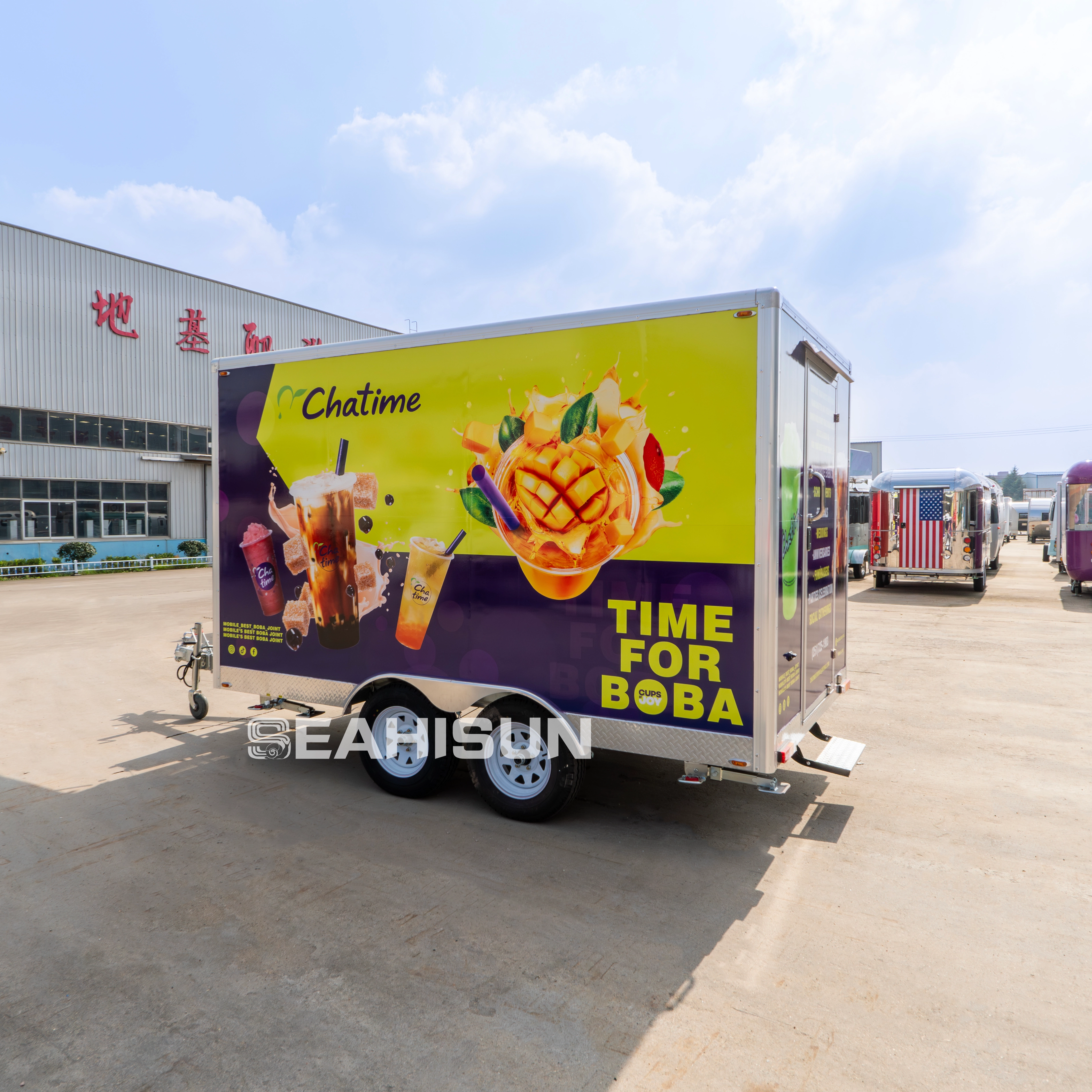
A customized wrap and bright neon signage effectively drive local foot traffic. However, your exterior branding must never interfere with operational hardware. Vinyl wraps should not cover ventilation grates, exhaust fans, or utility hookups. You must strike a balance between an eye-catching design and the mechanical needs of the unit.
Develop a smart service window strategy early. Pay close attention to the size and placement of your ordering windows. For bubble tea, a lower counter height works best. A dedicated pick-up ledge prevents disastrous spills during the customer hand-off. Customers frequently grab multiple tall cups at once, so they need a stable, wide ledge to organize their drink carriers.
Trustworthy implementation requires restraint. Beware of overly complex exterior modifications. Do not install massive non-standard awnings or fragile rooftop marquees. These elements complicate highway driving due to wind resistance. Furthermore, protruding exterior structures often violate local city ordinances regarding mobile vending dimensions. Keep the exterior aerodynamic, durable, and highly visible.
Evaluating Custom Food Trailer Manufacturers and Mitigating Risk
You must short-list builders based on hard evidence, not just attractive price tags. Finding a legitimate custom food trailer manufacturer dictates your long-term success. Many cheap builders cut corners on wiring and insulation. Establish strict criteria for vendor selection before signing any contracts.
Evaluate manufacturers using these specific criteria:
- Transparency: Do they provide detailed CAD drawings? Demand to see load-balancing charts before you pay any deposit.
- Compliance Guarantees: Will they guarantee their build passes your specific county health and fire codes? Get this promise in writing.
- Component Sourcing: Verify they strictly use NSF-certified or UL-listed components. Avoid unverifiable, imported pre-built trailers. They routinely lack standard US or EU compliance documentation.
Take specific next-step actions to protect yourself. Prepare your exact menu and a complete equipment specification list. Send this documented list to the manufacturer before requesting a quote. This vital step ensures highly accurate pricing and produces realistic build timelines. Do not assume builders know how heavy commercial boba equipment actually is.
Best Practice: Always request photos of their previous plumbing runs. Clean, organized, and properly strapped PEX piping indicates a professional manufacturer who cares about long-term vehicle durability.
Conclusion
Building a highly profitable mobile boba unit is a complex game of logistics, weight management, and layout optimization. Your ultimate success stems directly from treating the trailer as a high-efficiency manufacturing line. Every piece of equipment must sit in its logical place.
To succeed, prioritize utilitarian workflow rules over purely aesthetic decisions. Ensure your heavy-duty axles can comfortably support hundreds of pounds of liquid weight. Finally, heavily over-engineer your electrical systems to prevent disastrous mid-service power failures.
As your next step, firmly finalize your menu items immediately. Then, schedule a consultation with your local health department inspector. Clarify their specific sink dimensions and minimum fresh water volume requirements. Secure these exact numbers before you ever commit to a custom build contract.
FAQ
Q: How much does a custom bubble tea food trailer cost?
A: A realistic, evidence-based range spans from $15,000 to $40,000 or more. Plumbing complexity, heavy-duty axles, and high-capacity onboard power systems heavily drive this price variance. Cheaper models often require massive post-purchase upgrades to pass health inspections.
Q: Can I brew boba and tea directly on the trailer?
A: Yes, provided your trailer has adequate mechanical ventilation and proper fire-rated surfaces if using gas burners. You also need sufficient electrical capacity for commercial induction burners. However, many operators still prefer using a commissary kitchen to save limited onboard space.
Q: What size generator is needed for a boba trailer?
A: You typically need a minimum of 7,000 to 10,000 watts. You must carefully add up the starting wattage of sealers, fridges, and water heaters. Choosing a pure sine wave generator is also critical to protect sensitive equipment from power surges.
 注: 建议图片大小150px*50px


