

Views: 0 Author: Site Editor Publish Time: 2026-07-11 Origin: Site


Launching a mobile grill or BBQ business involves heavy equipment, intense heat, and strict regulations. You cannot rely on a standard concession trailer. A basic build simply will not survive the daily operational demands. It also will not pass rigorous compliance checks. Grill concepts face extreme stress from heavy smokers, flat-top grills, and constant grease production. You need serious structural support and robust ventilation.
Purchasing a poorly constructed rig risks failed inspections, serious towing hazards, and delayed launch dates. Unverified equipment compromises your entire business plan. Local authorities enforce strict rules regarding fire safety and weight limits. Ignoring these details leads to immediate operational roadblocks.
Securing a rigorously tested, DOT certified food trailer guarantees highway legality and structural integrity. It lays the foundation for a profitable, code-compliant grill operation. You will learn how to identify essential structural upgrades, navigate complex health codes, and evaluate builders effectively.
DOT approval means the Department of Transportation verified the unit for safe highway travel. It confirms National Highway Traffic Safety Administration (NHTSA) compliance. Manufacturers must issue a standardized 17-digit VIN. The build must feature approved exterior lighting, reflectors, and reliable braking systems. It ensures the vehicle behaves predictably at highway speeds.
Grill operations carry massive payloads. You transport heavy BBQ smokers, cast-iron grills, and dense raw meat inventory. Standard frames easily buckle under this load. A certified DOT food trailer guarantees the chassis and tow hitch are properly rated. This rating accounts for commercial payload dynamics. It prevents dangerous structural warping during transit.
You cannot legally register a towable food trailer without proper documentation. State DMVs require a valid Manufacturer’s Certificate of Origin (MCO). Insurance companies demand proof of DOT compliance before writing a policy. Without these documents, your unit cannot legally touch public roads. It becomes an unusable box sitting in your driveway.
Buying uncertified "bargain" trailers carries severe financial reality. Highway patrol officers can impound unverified units. Worse, a weak chassis can snap at highway speeds. This endangers public safety and destroys your expensive kitchen equipment. A certified unit protects your investment. It shields you from catastrophic liability claims.
Axles carry the entire weight of your mobile kitchen. You must evaluate single, tandem, and triple axles carefully. Single axles only handle light concession duties. Grill businesses almost exclusively require dual 5,200 lb or 7,000 lb axles. High-capacity tandem setups distribute the massive weight of smokers and commercial fryers safely.
| Axle Type | Typical Payload Capacity | Best For | Grill Business Suitability |
|---|---|---|---|
| Single Axle | Up to 3,500 lbs | Coffee, Shaved Ice, Pre-packaged food | Not Recommended |
| Tandem Axle (Dual) | 7,000 - 14,000 lbs | Burgers, Tacos, Standard BBQ | Highly Recommended |
| Triple Axle | 15,000+ lbs | Massive custom smokers, multi-station setups | Excellent for high-volume |
You need reinforced steel frames. A standard aluminum frame might warp under a 1,500-pound commercial smoker. Structural integrity requires heavy-duty cross members. Flooring choices also matter immensely. Aluminum flooring resists rust, but diamond-plate steel offers superior heat resistance. Diamond-plate endures brutal wash-down routines and dropped hot utensils. It stands up to the harsh daily realities of a grill operation.
Open-flame cooking generates immense radiant heat. You must mitigate this heat to protect your staff. Proper insulation prevents the exterior walls from blistering. Stainless steel heat shielding behind the grills is mandatory. It stops the intense temperatures from overwhelming your refrigeration units. Efficient heat management keeps your food safe and your crew comfortable.
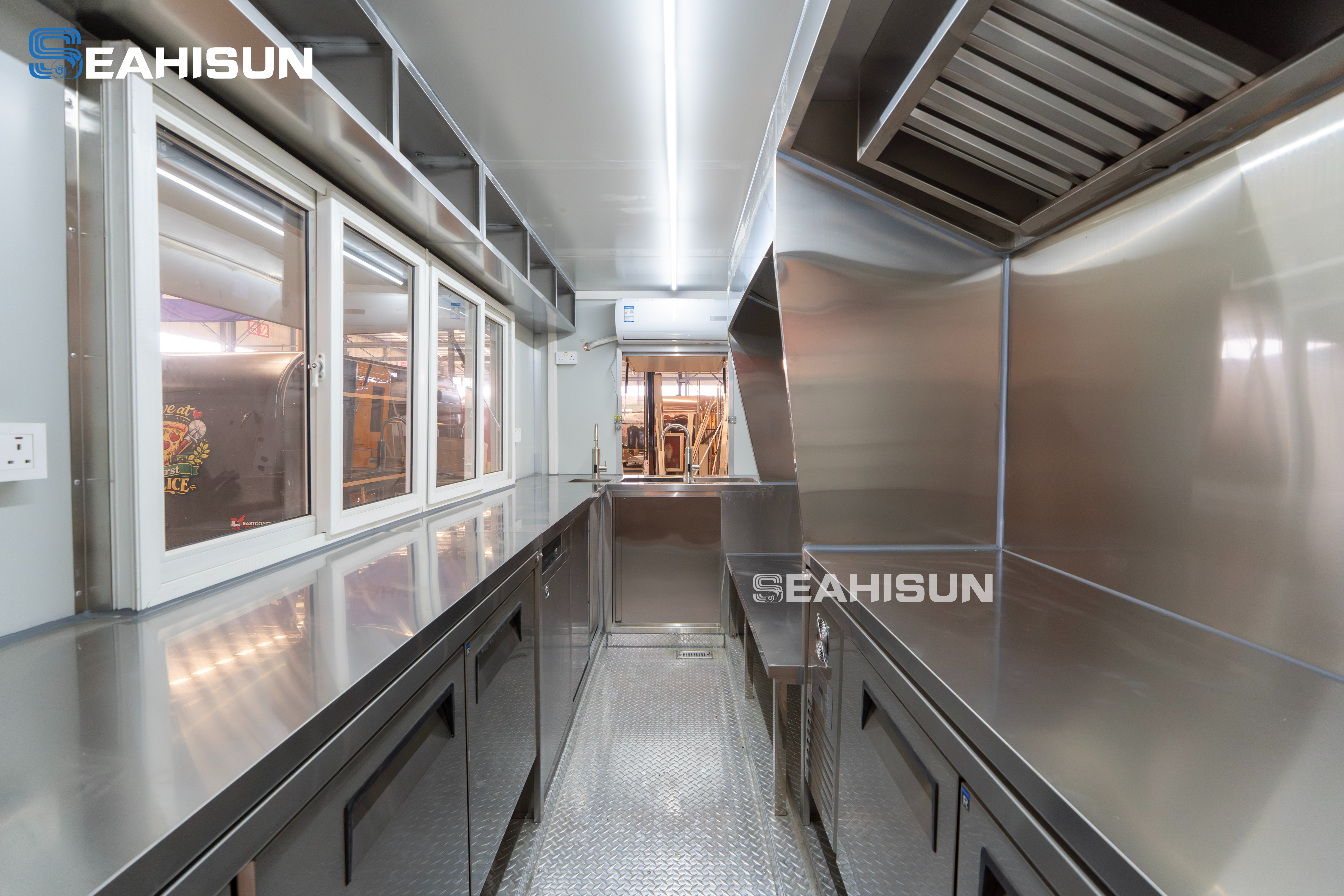
Any grease-producing or open-flame cooking requires a Type 1 commercial hood. This is a mandatory safety requirement for a mobile BBQ trailer. These hoods capture smoke, grease vapor, and extreme heat. They feature specialized baffle filters. You cannot substitute a residential vent. Health inspectors will immediately fail a unit lacking a properly sized Type 1 hood.
Commercial grill operations face high grease fire risks. ANSUL wet-chemical fire suppression systems are non-negotiable.
Here is how they protect your business:
You must understand pre-installation requirements. Local fire marshals demand specific schematic approvals before the builder installs the system. Get these blueprints approved early to avoid costly retrofits.
Propane systems require strict adherence to safety codes. Improper installations lead to catastrophic accidents. Follow these specific DOT guidelines for LP systems:
Trailer length directly dictates your revenue ceiling. You must evaluate the footprint based on expected daily transaction volume. Menu complexity also drives space requirements. A simple hot dog cart needs minimal prep area. A full-scale BBQ menu demands massive holding cabinets and multi-station prep tables. Choosing a unit that is too small cripples your service speed.
Industry veterans frequently choose the 18-foot model as the baseline for a grill food trailer. This size balances towing maneuverability with essential workspace. It easily accommodates a commercial hood, refrigeration, and necessary sinks. Smaller units force you to compromise on prep zones. Larger units become difficult to park at tight festival venues.
A smart layout prevents staff collisions during rush hours. You must establish distinct operational zones. Separate the "hot zone" from the "cold zone." Keep grills and fryers on one side. Place prep tables and refrigerators on the opposite wall or adjacent section.
You also need proper sanitation zoning. Integrate 3-compartment sinks and handwashing stations near the prep area. Position them so they do not bottleneck the cooking staff. Efficient zoning turns a cramped box into a highly productive commercial kitchen.
Many new operators confuse regulatory bodies. DOT cares about how the trailer travels. They inspect axles, lights, and weight ratings. The Health Department cares about how you handle food. They inspect sanitation, water temperatures, and refrigeration. Fire Marshals inspect hoods and suppression systems. You must satisfy all three agencies.
| Regulatory Body | Primary Concern | Key Inspection Items |
|---|---|---|
| DOT / DMV | Highway Safety | VIN, Axles, Brakes, Lights, Weight (GVWR) |
| Health Department | Food Safety & Sanitation | Sinks, Water Tanks, Surfaces, Refrigeration |
| Fire Marshal | Fire Prevention | Hoods, ANSUL systems, Propane lines, Clearances |
Do not assume a road-legal unit is ready to cook. Many buyers hit expensive roadblocks due to local code ignorance.
Your manufacturer must provide comprehensive paperwork. You need this documentation to submit to local health and fire inspectors. Request full schematic floor plans. Demand equipment specification sheets showing NSF and UL certifications. Secure the electrical and plumbing line diagrams. Without these, health inspectors will likely reject your permit application.
Transparent pricing is crucial when evaluating builders. Understand the difference between the base trailer cost and the customized build-out. Base prices only cover the empty shell and chassis. Customized grill installations, Type 1 hoods, and plumbing add significant expenses. You also face licensing and permit fees.
Beware of cheap quotes. Low bids often exclude heavy-duty axles. They might omit certified fire suppression systems. Cutting corners on a commercial grill trailer guarantees failed inspections. You will spend twice as much fixing a substandard build.
Demand transparent, line-item quotes from every prospective builder. You need to see exactly what you are paying for. Verify the builder’s National Association of Trailer Manufacturers (NATM) compliance. Confirm their DOT registration status. Check warranties on both the structural chassis and third-party commercial appliances. A reputable builder stands behind their craftsmanship and uses trusted equipment brands.
A successful mobile grill business starts with an infrastructure that won't fail under pressure. Securing a certified unit guarantees highway safety, structural durability, and fire code compliance. It protects your capital investment from costly fines and rebuilds.
Finalize your exact menu and equipment list before requesting a quote. This step ensures the manufacturer can accurately calculate the necessary GVWR and spatial requirements for your specific operation.
Do not risk your launch on unverified equipment. Contact a certified builder today for a compliance-aware consultation and a professional floor-plan draft.
A: Look for a 17-digit VIN permanently attached to the frame. Check for a DOT certification sticker on the trailer tongue or door frame. The manufacturer must also provide a valid Manufacturer’s Certificate of Origin (MCO) to prove compliance.
A: No. Standard trailers lack the chassis reinforcement and axle weight rating (GVWR) required for heavy cast-iron or steel smokers. Installing one in a basic build risks severe structural failure and highway accidents.
A: It depends on the Gross Combined Weight Rating (GCWR) of your tow vehicle and the trailer. Usually, if the combined weight exceeds 26,000 lbs, you need a CDL. Always check specific state laws.
A: Fire codes dictate specific exhaust fan CFM (Cubic Feet per Minute) ratings. They also determine fire suppression nozzle placements based on the exact BTU output of your chosen grill. Early spec approval ensures the build meets local codes.

 注: 建议图片大小150px*50px

