 注: 建议图片大小150px*50px

丨
注: 建议图片大小150px*50px


Views: 0 Author: Site Editor Publish Time: 2026-09-02 Origin: Site


Operating a dessert retail business in a high-traffic mall requires standing out in a saturated visual environment. You must capture wandering eyes instantly while still adhering to strict commercial property regulations. A cartoon IP bakery food cart bridges this vital gap between aesthetic attraction and daily operational utility. These highly themed units drive impulse foot traffic effectively. Families notice them immediately from a distance.
However, successfully procuring one involves balancing complex custom mold designs. You must integrate commercial-grade refrigeration requirements and pass rigid mall compliance checks. This comprehensive guide breaks down the necessary evaluation criteria. We explore designing, specifying, and sourcing a compliance-ready themed unit. You will learn actionable steps to deploy a mobile shop promoting smooth workflow. These insights ensure your investment delivers verifiable returns.
Visual disruption is critical in crowded retail corridors. Standard modular kiosks often blend into the background scenery. Shoppers walk past them without a second glance. Conversely, 3D cartoon designs disrupt the visual field completely. They create an immediate focal point. Consumers naturally gravitate toward recognizable or highly imaginative shapes. This immediate visual hook significantly lowers your customer acquisition friction.
Family demographic targeting benefits massively from this approach. Children spot engaging character designs quickly. Kids frequently persuade their parents to stop. This dynamic increases your baseline dwell time. Parents spend more time looking at the menu. More dwell time directly correlates to higher impulse purchase rates. You effectively turn a simple walkthrough into an active shopping experience.
Premium positioning happens naturally when you leverage custom enclosures. A specialized display cabinet cart elevates the perceived value of your products. Premium cupcakes, imported macarons, and branded baked goods look more appealing inside a bespoke unit. The environment matches the high-quality product inside. Customers willingly pay a premium price.
Scalability becomes easier once you finalize the initial design. Franchising requires strict brand consistency across multiple mall locations. Standardized IP molds guarantee exact replicas every time. You maintain visual uniformity whether operating in one city or ten. Let us look at a quick comparison chart illustrating these benefits.
| Feature Matrix | Standard Modular Kiosk | 3D Cartoon IP Cart |
|---|---|---|
| Visual Impact | Low. Blends into mall architecture easily. | High. Creates immediate visual disruption. |
| Family Appeal | Minimal. Lacks engaging elements. | Maximum. Triggers active child interest. |
| Perceived Value | Average. Viewed as standard retail. | Premium. Elevates product prestige. |
| Replication Speed | Fast (off-the-shelf). | Fast (after initial mold creation). |
Navigating mall lease requirements demands meticulous attention to detail. Mall management enforces strict spatial footprint restrictions. They also impose severe height limits. A commercial mall food trailer must obey "line of sight" rules. You cannot block neighboring storefronts from consumer view. Always request the property vendor guidelines before drafting any blueprints.
Electrical load safety remains a primary concern indoors. You must calculate the total power draw accurately. Add up your integrated refrigeration, LED lighting, and POS systems. Malls usually cap available power per kiosk pad. Exceeding this limit causes circuit trips. Ensure your manufacturer strictly follows UL or CE electrical standards. Mandate hidden wiring and waterproof industrial plugs for ultimate safety.
Sanitary codes dictate specific design choices. Health inspectors enforce strict NSF compliance guidelines. You must install durable sneeze guards. Hygiene shields over baked goods are non-negotiable. Self-contained handwashing sinks pose a unique challenge within a compact footprint. You must balance the mandatory fresh water and wastewater tank ratios carefully. Failure here halts operations immediately.
Fire safety and flooring protection wrap up the compliance checklist. Use only fire-retardant fiberglass resins for the exterior shell. Malls utilize expensive, premium flooring tiles. Heavy equipment easily scratches these surfaces. Specify non-damaging, polyurethane locking caster wheels. These wheels handle the weight while protecting the delicate tile underneath.
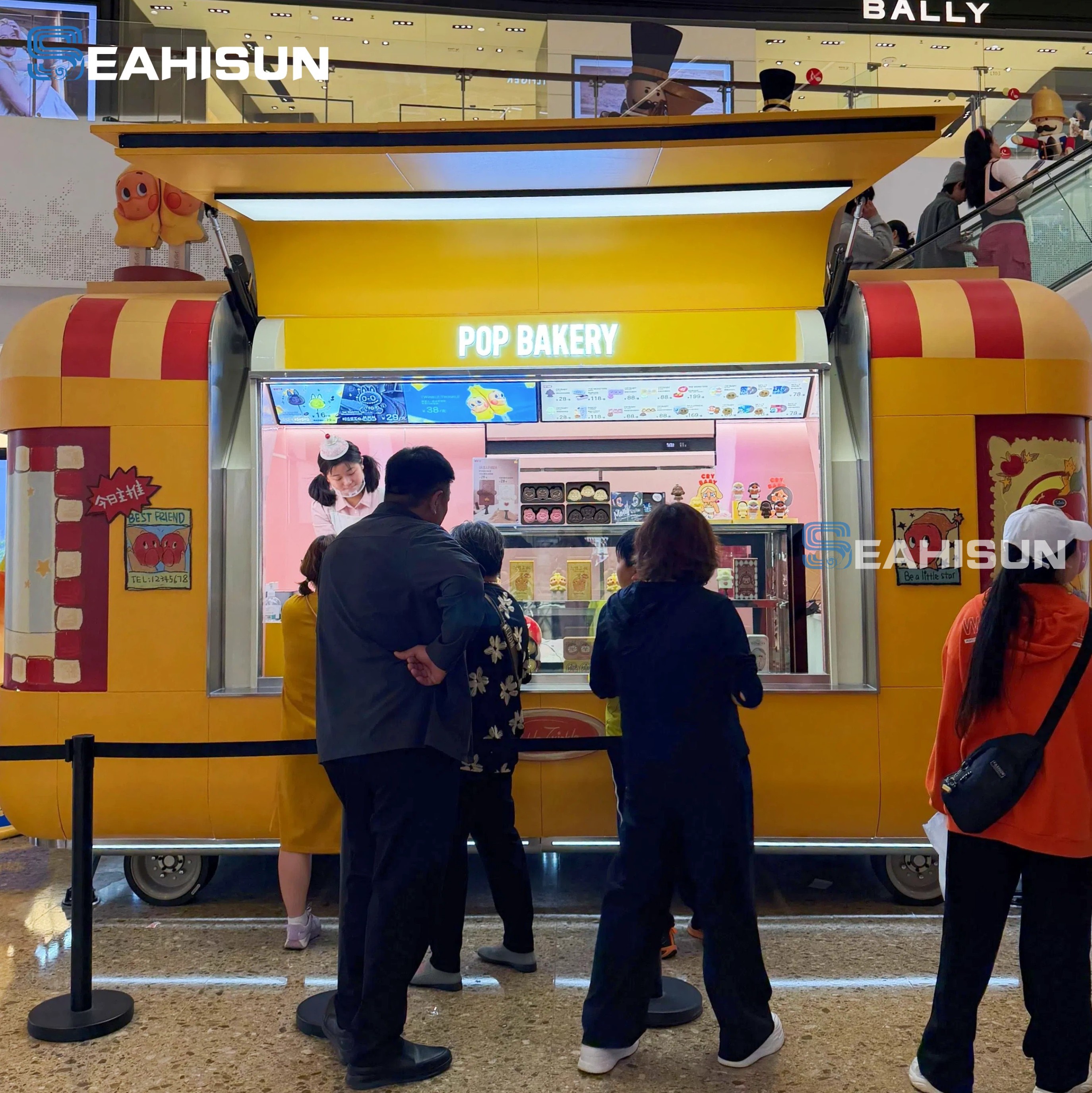
A high-converting dessert kiosk integrates specialized components seamlessly. The display integration acts as your primary sales engine. Use anti-fog, tempered curved glass. This choice maximizes product visibility during all hours. Shoppers need a clear view of your delicate pastries. Standard glass fogs up quickly over chilled items.
You must separate ambient and refrigerated sections smartly. Engineering the interior layout requires careful thermal management. Prevent compressor heat from escaping into the customer standing area. Hot exhaust air drives patrons away instantly. Proper ventilation protects the painted exterior from warping under sustained heat loads.
Ergonomic vendor workflow dictates your daily sales ceiling. Complex layouts cause service bottlenecks during peak weekend rushes. You can optimize the interior workspace using these specific layout principles:
Material durability forms the backbone of your investment. The exterior endures constant public interaction. Apply automotive-grade paint over the fiberglass shell. This provides crucial scratch resistance. It also guarantees UV stability if your unit sits under bright mall skylights. Inside the unit, prioritize 304 food-grade stainless steel. This material resists acidic cleaners and withstands relentless daily wear.
The customization journey begins long before manufacturing starts. First, you must navigate IP licensing laws. Acknowledge the strict legal necessities of intellectual property usage. Buyers must secure official rights before replicating any famous characters. Manufacturers will execute the design, but they do not secure licenses for you. Next, designers translate 2D character art into structurally sound 3D CAD models.
Mold creation involves unavoidable realities regarding lead times. Custom fiberglass molding typically requires four to six weeks. The resin needs specific curing intervals to achieve maximum tensile strength. Rushing the curing process leads to internal structural defects. The shell might crack during transport. Patience during this phase guarantees long-term durability.
Modular construction solves immense logistical headaches. A fully assembled bakery food cart rarely fits through standard commercial doors. Mall service elevators have strict dimension caps. Designers must engineer a modular, multi-piece assembly strategy. The unit arrives in sections. Your team bolts it together safely inside the mall corridor.
Branding application requires exacting precision. Strategic placement of backlit logos enhances visibility in dimly lit mall sections. Digital menu boards require custom mounting brackets. Color matching demands absolute perfection. Specify exact RAL or Pantone codes. This ensures your physical unit matches your established brand identity perfectly.
| Project Phase | Estimated Duration | Critical Milestone |
|---|---|---|
| 3D CAD Modeling | 1 - 2 Weeks | Final structural approval. |
| Fiberglass Mold Creation | 2 - 3 Weeks | Resin curing completion. |
| Steel Framing & Assembly | 1 - 2 Weeks | Refrigeration integration. |
| Painting & Finishing | 1 Week | Automotive clear coat application. |
Choosing the right fabrication partner dictates your project's success. Start by conducting strict portfolio verification. Look closely for manufacturers showcasing proven indoor case studies. Building an indoor custom food cart requires different skills than outdoor street units. Indoor environments demand tighter tolerances and whisper-quiet compressors.
You must balance engineering with aesthetics. Beware of vendors prioritizing exterior looks alone. They often compromise on essential mechanical needs. A beautiful cart fails if the compressor lacks proper ventilation. Structural weight balance matters immensely. Top-heavy fiberglass designs pose a tipping hazard when pushed.
Assess their warranty and after-sales support thoroughly. Mechanical components face relentless daily use. You need clear answers on several critical support questions:
Finally, review their global shipping protocols. Fragile fiberglass displays require specialized cradling. B2B vendors must package these units robustly for international freight. They typically utilize heavy-duty wooden crates. Inside, thick foam bracing prevents the unit from shifting. Proper packaging prevents catastrophic transit damage before it reaches your local port.
A: It generally ranges from 1.5kW to 3kW. This depends heavily on the display cabinet size and integrated LED lighting. Always verify your specific mall kiosk pad power caps before finalizing the cart specification.
A: Yes. You can move them utilizing heavy-duty polyurethane locking casters. However, they are typically designed for semi-permanent placement rather than daily, long-distance rolling across uneven surfaces.
A: Expect 1-2 weeks for initial 3D design and revisions. You need an additional 4-6 weeks for mold creation, fabrication, and testing. This timeframe entirely excludes international freight transit time.
A: No. Buyers must secure the legal rights to use a specific cartoon IP themselves. Manufacturers will only execute the physical design based on the approved artwork provided by the licensed buyer.

