High-volume commercial catering demands a careful balance. You must weigh operational capacity against brand perception. Striking this balance defines your market success. A 5-meter footprint offers the perfect middle ground. It is large enough to house a high-output kitchen. Yet, you will find it maneuverable enough for tight urban venues. Coupling this size with a sleek, dark exterior signals premium service. You can seamlessly cater corporate events, luxury weddings, and high-end festivals.
However, visual appeal alone will not sustain a business. Evaluating a black custom food truck requires moving past surface aesthetics. You must critically assess equipment load capabilities. We also need to examine strict health code compliance. Finally, rigorous fabrication quality dictates long-term durability. This guide reveals how to specify and select your ideal mobile kitchen. You will learn layout strategies, climate control upgrades, and vendor verification steps.
Key Takeaways
- A 5m food truck comfortably fits 3–4 staff members and allows for a full standard commercial kitchen layout (prep, cook, serve, and wash stations).
- Black exteriors offer superior high-end branding but require upgraded HVAC systems and specialized finishes to manage heat absorption and maintain durability.
- Commercial viability depends heavily on custom fabrication quality, particularly regarding payload capacity, electrical load balancing, and integrated fire suppression.
- Shortlisting builders should rely on industrial fabrication credentials, warranty terms, and transparent lead times, rather than base price alone.
Defining the 5m Advantage for Mobile Catering Trucks
Standard 3-meter trailers consistently bottleneck high-volume events. They simply lack the physical space for adequate equipment. Staff members bump into each other during peak rushes. Output drops, and lines grow unmanageably long. Conversely, massive 7-meter rigs pose severe logistical nightmares. They severely limit your access. You will find them impossible to park in profitable, space-restricted urban venues.
A 5-meter footprint solves this core business problem. It optimizes the mobile "kitchen triangle" perfectly. Three to four line cooks can operate simultaneously inside. They can pivot quickly between cold storage, hot cooking surfaces, and the service window. You maximize throughput without sacrificing employee comfort. This spatial efficiency directly drives daily revenue.
Menu flexibility also expands dramatically with this size. You can install dual cooking lines. For instance, you can mount commercial fryers right alongside flat-top grills. Even with heavy cooking equipment, you still retain ample space. A 5-meter chassis easily accommodates the mandatory triple-sink sanitation stations. You never have to compromise your menu to meet basic health codes.
Towability remains a critical factor for any mobile catering truck. A fully loaded 5-meter unit carries significant weight. You must understand realistic towing logistics before purchasing.
- Gross Vehicle Weight Rating (GVWR): Fully loaded units often exceed 7,000 lbs. You must pair them with a highly capable tow vehicle.
- Dual-Axle Necessity: Single axles cannot support this weight class safely. Dual axles provide essential stability during highway transit.
- Braking Systems: Integrated electric trailer brakes are non-negotiable. They prevent dangerous jackknifing incidents in sudden traffic stops.
- Hitch Class Requirements: You will need a Class IV or Class V weight-distributing hitch. This ensures the tow vehicle maintains front-wheel traction.
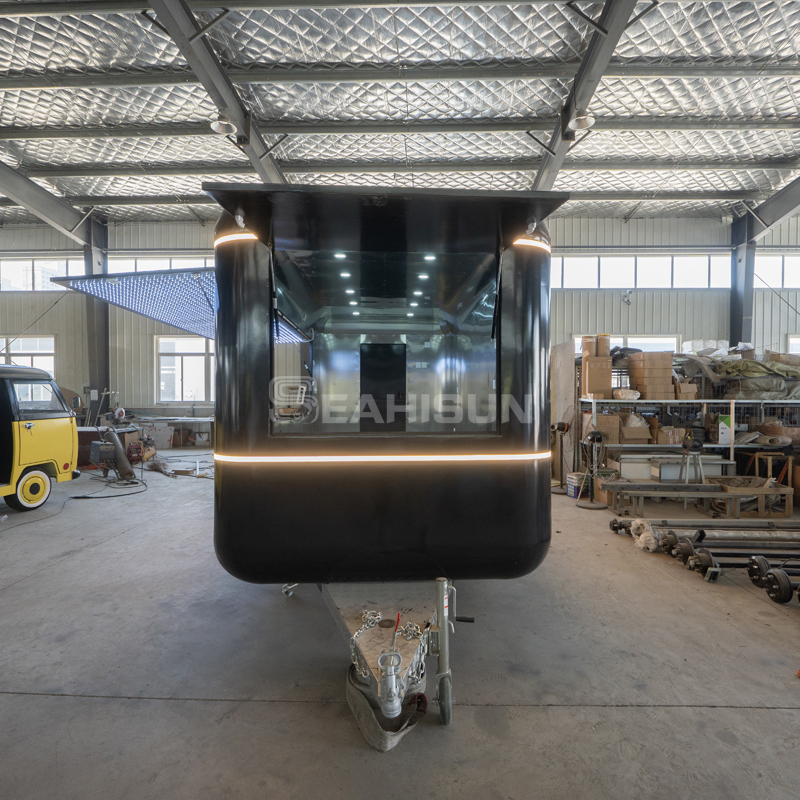
Essential Layouts for a Commercial Food Trailer
Designing the interior layout requires careful strategic planning. You cannot use a generic floor plan for specialized menus. We must break down layout approaches based on exact service requirements. Different menus demand entirely different workflows.
| Layout Strategy | Primary Equipment Focus | Workflow Priority | Best For |
| High-Volume Quick Service | Expanded service windows, heated holding cabinets, multiple POS systems. | Rapid assembly and immediate customer handoff. | Music festivals, stadium events, street fairs. |
| Gourmet Prep-Heavy | Expansive stainless steel counters, under-counter refrigeration, dedicated prep sinks. | Complex plating, ingredient staging, and strict cross-contamination control. | Weddings, corporate catering, private chef events. |
Weight distribution stands as your biggest risk management priority. It is essential when designing any commercial food trailer. You must balance heavy equipment perfectly over the dual axles. Commercial fryers hold gallons of dense oil. Fresh water tanks add hundreds of pounds when full. Generators represent massive point loads. If you place these heavy items too far back, the trailer will sway violently. If you place them too far forward, you will crush the tow vehicle's suspension. Safety dictates centering the heaviest loads directly above the wheels.
Power and plumbing infrastructure form the heart of your operation. You must calculate your total peak amperage accurately. Add up the draw from your refrigeration, hood fans, water pumps, and lighting. Always build in a 20% safety margin to prevent tripped breakers during service. Furthermore, specify adequate fresh and gray water tank capacities. Continuous 8-hour catering shifts consume significant water. Running dry mid-event destroys your service timeline.
The "Black Custom Food Truck" Aesthetic: Realities & Solutions
Visual branding directly impacts your pricing power. A sleek black food trailer commands an immediate premium perception. It visually separates your business from standard carnival-style food carts. This high-end aesthetic proves highly effective for lucrative B2B catering. Event planners actively seek elegant setups for brand activations and private weddings. Black provides a sophisticated, modern backdrop. It elevates the perceived value of your menu items before the customer even orders.
However, we must view this aesthetic through a skeptical lens. The physical reality of dark metal in direct sunlight is brutal. Black exteriors absorb massive amounts of solar radiation. The interior temperature can skyrocket rapidly. This heat threatens both equipment performance and staff safety. You cannot ignore this physical limitation.
To succeed, you must implement aggressive heat mitigation strategies:
- Upgraded HVAC Systems: Standard cooling fails here. You must install dual roof-mounted AC units to combat the combined heat of cooking and solar absorption.
- High-CFM Exhaust Hoods: Invest in high-velocity ventilation. Pulling hot air out quickly is just as important as pumping cold air in.
- Advanced Insulation: Require maximum-density foam insulation in the walls and ceiling. Reflective barriers help block radiant heat transfer.
- Specialized Finishes: Specify high-grade, UV-resistant paint. Standard matte finishes often chalk and fade quickly. You need marine-grade or automotive-grade clear coats.
Beyond heat management, a dark exterior offers excellent wrap and decal readiness. A black base serves as the ideal negative space. You can apply high-contrast vinyl lettering. Bright logos pop brilliantly against the dark background. It provides maximum legibility from a distance. You save money by using partial die-cut decals instead of full-body wraps.
Navigating Compliance and Industrial Fabrication Standards
Aesthetics and layout mean nothing without strict compliance. You must ensure your custom food truck meets all local and national codes. Health departments evaluate dimensions meticulously. Fire marshals inspect every joint. Failing these inspections stops your business immediately.
First, demand NSF-certified components. This is a non-negotiable requirement. Health inspectors look for the NSF stamp on sinks, prep tables, and refrigeration units. It proves the surfaces are commercial-grade. It shows they are easily sanitizable. Porous materials or residential-grade appliances will result in instant failure.
Fire suppression and ventilation demand equal scrutiny. If you cook with grease or produce smoke, you need a Type 1 commercial hood. You also must install automated fire suppression systems. The Ansul system represents the industry standard. It automatically detects fire, cuts the fuel supply, and covers the cooking surface in chemical foam. Proper grease containment filters are also mandatory to prevent duct fires.
Electrical and gas certifications present high failure risks. Uncertified wiring causes devastating fires. Improper gas line routing creates lethal explosion hazards. Never accept a build without certified pressure tests. Your local health department will demand documentation. They will inspect the gas manifold, regulators, and electrical panel. Always hire fabricators who employ certified electricians and gas fitters.
How to Evaluate Builders and Request a Quote
The manufacturing market is flooded with low-quality options. You must differentiate between genuine industrial fabricators and high-markup resellers. Resellers often import cheap, pre-built shells. They retrofit them poorly and hide structural flaws behind shiny diamond plate. True fabricators weld the chassis from raw steel. They engineer the electrical runs from scratch.
Use strict verification criteria to shortlist your builders. Do not hand over a deposit based on a flashy Instagram photo. Follow these specific evaluation steps:
- Request Engineering Documents: Ask for detailed CAD drawings before signing anything. Demand weight distribution charts. A legitimate fabricator provides these standard.
- Evaluate Timeline Transparency: Discuss the build timeline openly. A fully custom 5m unit typically takes 8–12 weeks. Be highly suspicious of anyone promising a 3-week turnaround.
- Assess After-Sales Support: Read the warranty terms closely. Look for structural guarantees on the chassis and welds. Ask about their protocol for replacing faulty equipment.
- Verify Certifications: Ensure they are licensed manufacturers. Check if they provide DOT (Department of Transportation) compliance documentation for highway use.
Your next step requires careful preparation. Do not ask for a generic "ballpark" price. You will receive an inaccurate, padded quote. Instead, finalize your exact menu first. From that menu, build a comprehensive equipment list. Specify the exact sizes of flat-tops, fryers, and fridges. Bring this detailed list to your short-listed manufacturers. A precise equipment list guarantees an accurate proposal for your 5m food truck.
Conclusion
Investing in a custom 5-meter unit is a serious strategic move. It perfectly positions operators to target high-ticket events. You achieve maximum operational volume without the logistical headaches of a massive rig. The custom black finish secures premium branding opportunities. It attracts corporate clients and upscale private events.
However, you must remain vigilant during the procurement process. Aesthetic appeal must be backed by industrial-grade fabrication. You need rigorous climate control systems to combat heat absorption. Strict adherence to health and fire codes ensures your business stays operational. Never compromise on NSF-certified equipment or proper weight distribution.
Take action today by mapping out your exact service workflow. Finalize your non-negotiable equipment list based on your menu. Then, begin requesting specific CAD layout proposals from carefully vetted fabricators. Demand transparency, prioritize safety, and build a mobile kitchen designed for lasting success.
FAQ
Q: How much does a fully equipped 5m black custom food truck cost?
A: Costs vary significantly based on equipment. A bare-bones shell might start lower, but a fully equipped commercial kitchen typically ranges from $45,000 to $85,000+. Custom black paint finishes, necessary dual HVAC upgrades, and premium fire suppression systems will push the final cost toward the higher end of that spectrum.
Q: What kind of vehicle is required to tow a 5m commercial food trailer?
A: A fully loaded 5m unit often exceeds a 7,000 lb Gross Vehicle Weight Rating (GVWR). You must use a heavy-duty tow vehicle. A 3/4-ton pickup (like an F-250 or 2500 series) or a 1-ton truck is highly recommended. Always use a weight-distributing hitch with integrated trailer brake controllers.
Q: Are matte black food trucks harder to keep clean?
A: Yes, matte black finishes demand more maintenance. While gloss finishes wipe down easily, matte surfaces tend to show grease spots, fingerprints, and road dust very clearly. In a commercial catering environment, you will need frequent, careful washing with specialized matte-safe soap to maintain the premium aesthetic.
Q: How long does it take to build a custom 5m food truck?
A: Standard industry lead times run between 8 and 12 weeks. This timeframe includes initial CAD design, custom chassis fabrication, electrical/plumbing routing, and final equipment installation. Supply chain variables, particularly regarding specialized commercial appliances or specific paint curing times, can occasionally extend this schedule.
 注: 建议图片大小150px*50px


