Operating a dual-concept mobile kitchen demands far more than merely squeezing heavy appliances into a tight space. You are merging two entirely different culinary operations under one metal roof. This setup quickly tests your logistical planning skills. Managing the heavy smoke of a BBQ chicken food trailer alongside the high-speed assembly of a taco food trailer introduces severe workflow, ventilation, and compliance challenges. You must constantly balance extreme heat output against strict health department standards. Careful equipment selection prevents critical operational failures during peak service hours.
This guide thoroughly breaks down the technical equipment requirements, structural payload limitations, and rigorous evaluation criteria you need. We will show you how to design a code-compliant, high-output mobile kitchen. You will learn exactly how to optimize your physical layout, select appropriate ventilation, and scale your business without wasting capital on the wrong commercial hardware.
Key Takeaways
- Ventilation dictates design: BBQ operations require specialized Type-1 exhaust hoods and fire suppression systems that consume significant payload and budget.
- Workflow zoning is critical: Strict physical separation between raw poultry prep and ready-to-eat taco assembly is legally required to pass health inspections.
- Payload vs. Power: Balancing the weight of a commercial smoker with generator capacity determines your trailer's operational limits.
- Commercial-grade is non-negotiable: Residential equipment will void warranties, fail health inspections, and break down under road vibrations.
The Operational Realities of a Multi-Concept Menu
Combining two distinctly different cuisines introduces complex operational hurdles. You are attempting to merge two unique prep speeds within a single mobile environment. Barbecue requires a slow, methodical approach. Tacos demand rapid-fire assembly. Bridging this gap requires highly intentional equipment planning.
Framing the Business Problem
You cannot simply place a smoker next to a taco prep table and expect smooth operations. Barbecue chicken relies on long cook times, generating high volumes of ambient heat and airborne grease. Tacos require fresh, crisp ingredients kept safely out of the temperature danger zone. This massive temperature differential creates severe environmental stress inside a small mobile kitchen. Employees will struggle if they must constantly pivot between a blistering smoker and a delicate cold-prep station.
Workflow Bottlenecks
Space allocation quickly becomes your biggest enemy. You must evaluate the sheer volume of space required for hot-holding large quantities of smoked meat. At the same time, you must account for the extensive cold-holding needs of fresh taco garnishes like cilantro, diced onions, and salsas. Poor spatial planning creates physical bottlenecks where cooks constantly bump into one another.
To eliminate these bottlenecks, consider this standard workflow sequence:
- Receiving and Storage: Separate bulk raw meats from delicate produce immediately upon loading.
- Active Cooking Zone: Confine all heavy smoke, grease, and open flames to the rear or designated exhaust zone.
- Hot Holding Transition: Move cooked BBQ chicken directly into proximity of the assembly line without crossing raw prep areas.
- Final Assembly: Dedicate a forward-facing station exclusively to rapid taco building and order fulfillment.
Cross-Contamination Risks
Health departments heavily scrutinize multi-concept trailers. Establish strict success criteria for your health department approval by designating distinct zones. You must create a clearly defined "dirty" zone for handling raw chicken. You must also designate a "clean" zone for produce and taco prep. Never allow utensils or cutting boards to cross these invisible boundaries. Falsifying this separation will guarantee an immediate health code failure. Many successful operators use color-coded smallwares to enforce this visual separation during chaotic lunch rushes.
Primary Cooking Equipment & Heavy-Duty Ventilation
Your cooking equipment forms the functional core of your business. However, heavy-duty commercial appliances demand rigorous structural support and massive energy draws. Selecting the right hardware ensures long-term viability.
Smokers & Grills
You face a difficult choice between offset smokers and vertical rotisserie smokers. Offset smokers offer incredible flavor profiles and authentic curb appeal. Unfortunately, they consume immense floor space and add severe payload stress. Vertical rotisserie smokers maximize cubic volume instead of square footage. They utilize space much more efficiently. Furthermore, you must choose your fuel type carefully. Wood and charcoal generate better bark but require extensive fire safety compliance. Propane systems offer automated temperature control and reduce your daily labor burden.
Flat Top Griddles & Fryers
Taco assembly relies heavily on high-recovery flat top griddles. You must size your griddle appropriately to toast tortillas and sear secondary proteins simultaneously. Forward-thinking owners also size their griddles to accommodate future menu expansions. A large enough griddle easily allows you to operate as a hamburger food trailer during the off-season.
Additionally, consider installing dual-vat commercial fryers. Expanding your sides menu significantly increases your average ticket size. Integrating commercial fryers transforms your setup into a highly profitable fried chips trailer alongside your main offerings. Just remember to account for the massive oil weight during transit.
The Ventilation Mandate (Type 1 Hoods)
High-grease and high-smoke cooking legally mandate specialized stainless steel exhaust systems. You cannot compromise here.
- Type-1 Hoods: These systems extract grease-laden vapors. They feature specialized baffle filters and require integrated make-up air units to prevent suffocating the trailer interior.
- Ansul Fire Suppression: Local fire marshals require chemical suppression systems over open flames and fryers. These systems automatically deploy fire-retardant foam if temperatures exceed a critical threshold.
- Clearance Rules: You must maintain mandatory spacing between open flames and fryers. A minimum of 16 inches of clearance, or a stainless steel vertical baffle, is legally required to prevent flare-ups from igniting fryer oil.
Below is a typical equipment specification table to help you compare dimensional and utility needs:
| Equipment Type | Average Width | Primary Utility | Ventilation Required |
| Vertical Smoker | 36 - 48 inches | Propane / Wood | Type 1 Hood |
| Commercial Griddle | 24 - 48 inches | Propane | Type 1 Hood |
| Dual Vat Fryer | 16 - 32 inches | Propane | Type 1 Hood |
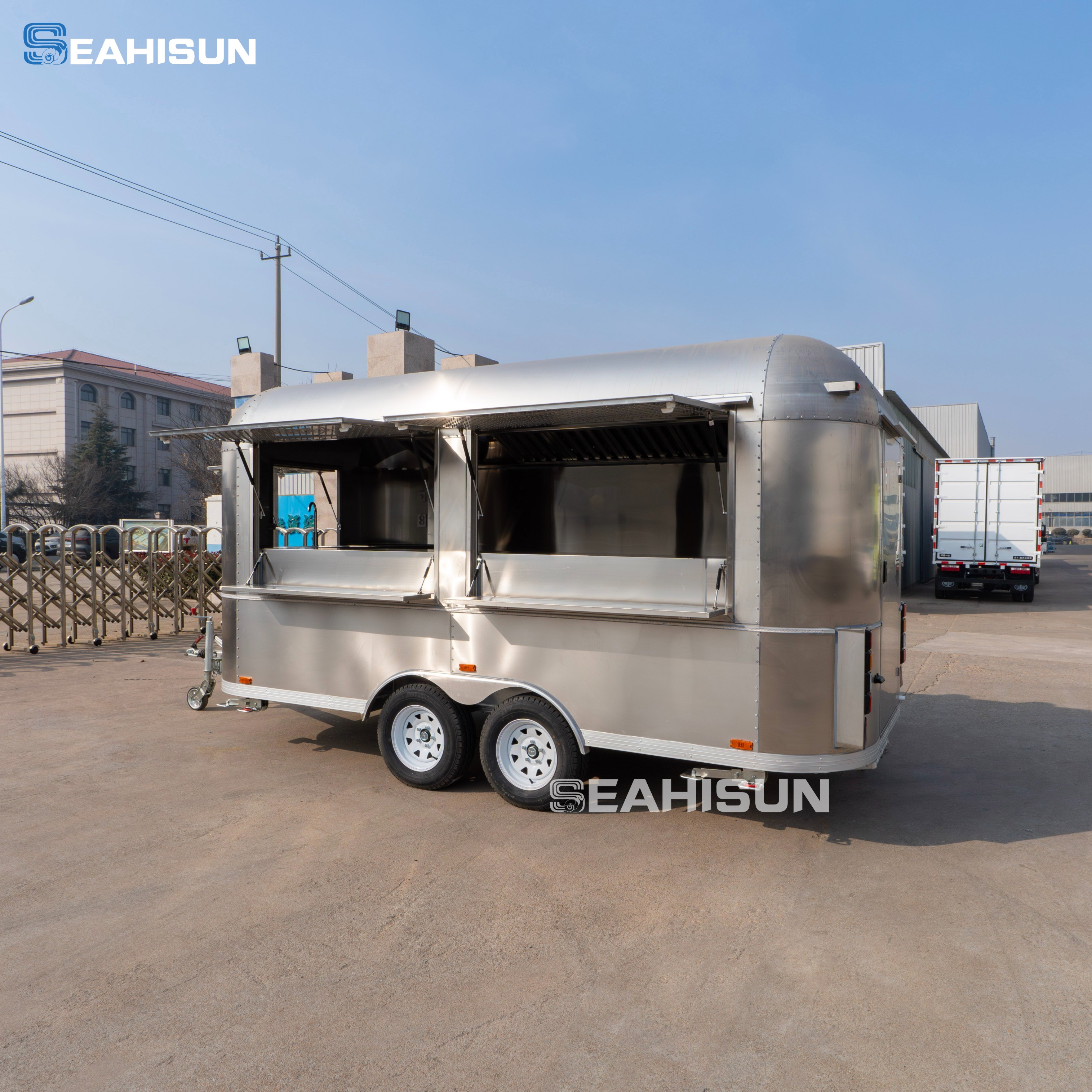
Refrigeration, Prep Stations, and Workflow Zoning
Keeping ingredients fresh while operating adjacent to a blistering smoker tests the limits of commercial refrigeration. Strategic spatial zoning protects your product and your customers.
Under-Counter vs. Upright Refrigeration
Assess your floor space against your required cubic storage. Upright reach-in refrigerators hold massive volumes of bulk prep. However, they block sightlines and consume valuable wall space. Under-counter units provide a brilliant dual-purpose solution. They offer essential cold storage while doubling as functional prep surfaces. We highly recommend under-counter units equipped with prep-top condiment rails. These rails are absolutely optimal for high-speed taco assembly lines. They keep salsas and garnishes chilled while remaining instantly accessible to your line cooks.
Raw Meat Storage
Raw poultry represents your highest food safety liability. Compliance requirements strictly dictate how you store raw chicken. You must keep it securely at the very bottom of dedicated refrigeration units. This prevents contaminated blood or juices from dripping onto ready-to-eat produce. Many inspectors prefer entirely separate refrigerators for raw proteins and fresh vegetables. If you share a unit, strictly enforce the bottom-shelf rule using sealed, commercial-grade lexan bins.
Hot Holding Systems
BBQ chicken loses its quality rapidly if mishandled after the smoke. You must evaluate proofing cabinets or specialized countertop warmers. These systems keep cooked meat safely above 135°F without drying out the delicate proteins. High-humidity holding cabinets work best for large volumes of pulled chicken. They maintain safe serving temperatures while preserving crucial moisture.
Stainless Steel Prep Tables
Prioritize marine-edge prep tables throughout your workspace. A marine edge features a slightly raised rim around the table's perimeter. This subtle design detail contains grease spills, runaway juices, and dropped ingredients. It prevents liquids from cascading down onto the floor, reducing severe slip hazards. A fully stainless steel food trailer environment withstands the heavy processing of raw meats while remaining incredibly easy to sanitize.
Core Infrastructure: Power, Plumbing, and POS Integration
Behind the shiny equipment lies the invisible infrastructure dictating your success. Power and plumbing failures shut down mobile kitchens faster than any other factor.
Calculating Power Loads
Formulating an accurate power matrix prevents disastrous electrical failures. You must calculate both Starting Watts and Running Watts. Commercial refrigeration compressors draw massive surges of energy when they kick on. If multiple compressors start simultaneously alongside your exhaust fan, they will trip your breakers.
Undersizing the generator remains the most common reason a restaurant trailer fails during peak service. Always calculate your total running wattage, add your highest starting wattage surges, and pad the total by at least 25%. This buffer ensures your generator handles the extreme summer heat when refrigeration works hardest.
Use this basic Power Load Chart to estimate your required generator size:
| Component | Running Watts (Est.) | Starting Surge (Est.) |
| Exhaust Hood Fan | 600W | 1,200W |
| Under-Counter Fridge | 800W | 2,400W |
| Water Heater | 1,500W | 1,500W |
| A/C Unit (Optional) | 2,000W | 3,500W |
Plumbing Systems
Your plumbing system dictates your maximum operational hours. Health codes require a 3-compartment sink for washing, rinsing, and sanitizing. You also need a dedicated, heavily monitored handwash station. Sizing your water tanks requires strict adherence to local laws. Fresh water tanks provide your clean supply. Your gray water tank catches all wastewater. Legally, the gray water tank must typically be 15% to 50% larger than your fresh water capacity. This buffer guarantees you never overflow contaminated water onto public streets.
Point of Sale (POS) & Tech Stack
Do not let technology become an afterthought. Integrate compact, cloud-based hardware into your service window. Modern POS terminals and Kitchen Display Systems (KDS) eliminate confusing paper tickets. You must select hardware rated for harsh, high-heat environments. Standard consumer tablets often overheat and shut down near commercial grills. Ensure your software easily tracks separate inventory metrics for bulk BBQ proteins and highly perishable taco ingredients.
Compliance, Payload Limits, and Procurement Strategy
Building a commercial kitchen on wheels requires serious engineering. Ignorance of payload limits destroys axles and voids insurance policies.
Weight Distribution (GVWR)
Your trailer's Gross Vehicle Weight Rating (GVWR) marks the absolute maximum weight it can safely carry. Overloading axles leads to catastrophic blowouts on the highway. Heavy equipment requires intense scrutiny. You must place commercial smokers, massive fryers, and full water tanks directly over or slightly ahead of the axles. Poor weight distribution causes violent trailer sway at high speeds. Always calculate the weight of your fresh water tank when fully loaded; water weighs over eight pounds per gallon.
Material Standards
Health inspectors strictly enforce material codes. A fully compliant interior relies on non-porous surfaces. Standardized health compliance, fire safety, and sanitation rules demand stainless steel walls behind cooking equipment. Aluminum or FRP (Fiberglass Reinforced Plastic) works for ceilings and prep zones, but heavy grease environments benefit massively from stainless steel durability. Diamond-plate aluminum flooring offers excellent slip resistance during hectic shifts.
Shortlisting Logic
Procuring your equipment requires a strategic mindset. Avoid emotional purchases.
- Retrofit vs. Custom Build: Evaluating the hidden costs of retrofitting a used trailer often reveals nasty surprises. Used trailers rarely possess the structural framing required for heavy BBQ ventilation. Commissioning a custom build tailored specifically to heavy smoke extraction usually saves money over a three-year horizon.
- NSF Certification: You must verify all shortlisted equipment carries NSF (National Sanitation Foundation) and UL commercial ratings. Residential appliances will void your insurance, fail municipal health inspections, and immediately break down under constant road vibrations.
Conclusion
Transitioning from a menu concept to a fully operational mobile kitchen hinges on honest payload math, rigorous ventilation planning, and strict health department compliance. Merging barbecue operations with taco assembly requires you to heavily prioritize spatial zoning to prevent dangerous cross-contamination. Always remember to avoid cutting corners on specialized exhaust hoods or commercial generator sizing, as these represent the lifeblood of your operation.
Your immediate next step is to finalize your menu's peak output volume. Draft a schematic floor plan based entirely on those volume numbers. Finally, consult with a certified commercial builder to aggressively validate your weight distribution math and ensure alignment with local fire safety codes.
FAQ
Q: Can I use a standard exhaust hood for a BBQ chicken food trailer?
A: No. Cooking raw poultry and operating smokers requires a Type-1 commercial hood with an integrated fire suppression system and adequate make-up air to handle heavy grease and smoke.
Q: How do I prevent cross-contamination in a small trailer?
A: Implement strict zoning: utilize separate cutting boards, designate specific refrigeration units (or lowest shelves) strictly for raw poultry, and position the handwashing sink between the raw prep and taco assembly stations.
Q: Do I need a commercial generator, or will an inverter work?
A: You need a commercial-grade generator. Standard inverters rarely support the starting wattage required by commercial refrigeration compressors, water heaters, and exhaust fans running simultaneously.
Q: What is the required ratio for fresh to gray water tanks?
A: Most health departments require the gray water (wastewater) tank to be at least 15% to 50% larger than your fresh water tank to prevent overflow during service.
 注: 建议图片大小150px*50px


