

Views: 0 Author: Site Editor Publish Time: 2026-06-22 Origin: Site


Launching a successful brand pop-up requires absolute operational precision. You need a mobile asset. It must capture consumer attention instantly. It also must handle demanding crowds flawlessly. In the fast-paced world of experiential marketing, your mobile vehicle serves as the literal face of your campaign. If it fails visually, people walk past. If it fails operationally, your staff collapses under peak rush-hour pressure.
Marketers face a constant daily dilemma. They struggle to balance visual magnetism against back-of-house efficiency. Two primary vehicle architectures dominate the modern mobile event space. You have the retro-styled Airstream. You also have the utilitarian square trailer. Making the wrong choice severely hurts your bottom line and ruins your event ROI.
Our objective is very clear. We provide experiential marketers and food operators a no-nonsense framework. You need an ROI-focused method for choosing the right mobile asset. This guide breaks down space metrics, aesthetic value, and daily output realities. You will learn exactly how to evaluate your options. We will show you which specific model guarantees your operational success.
First, you must define your primary activation goal. Do you want to capture foot traffic? Are you prioritizing user-generated content (UGC)? Or do you need to drive high-volume food sales? A stunning brand pop-up trailer serves different purposes based on these distinct goals. Experiential activations focus heavily on brand impressions. They rely on aesthetics to draw crowds for product sampling. Transactional setups prioritize speed and menu output. You cannot optimize for both equally. You must choose a primary objective before contacting a fabricator.
Many operators initially consider motorized trucks. However, trailers perform much better for multi-day events. A motorized custom food truck carries heavy mechanical risks. Engine failure can completely ruin an entire weekend activation. Trailers offer superior footprint flexibility. They operate as semi-permanent structures. You can drop them at a location and drive the tow vehicle away. This creates a much cleaner, more approachable event footprint for your customers.
Aesthetics matter greatly to your marketing team. However, you must map out your operational realities first. Determine your required kitchen footprint. Calculate your exact staff headcount. Identify your necessary holding capacities for hot and cold food. Do this long before looking at exterior design options. If your menu requires four staff members, a tiny vintage shell will fail. Operations always dictate your baseline spatial needs.
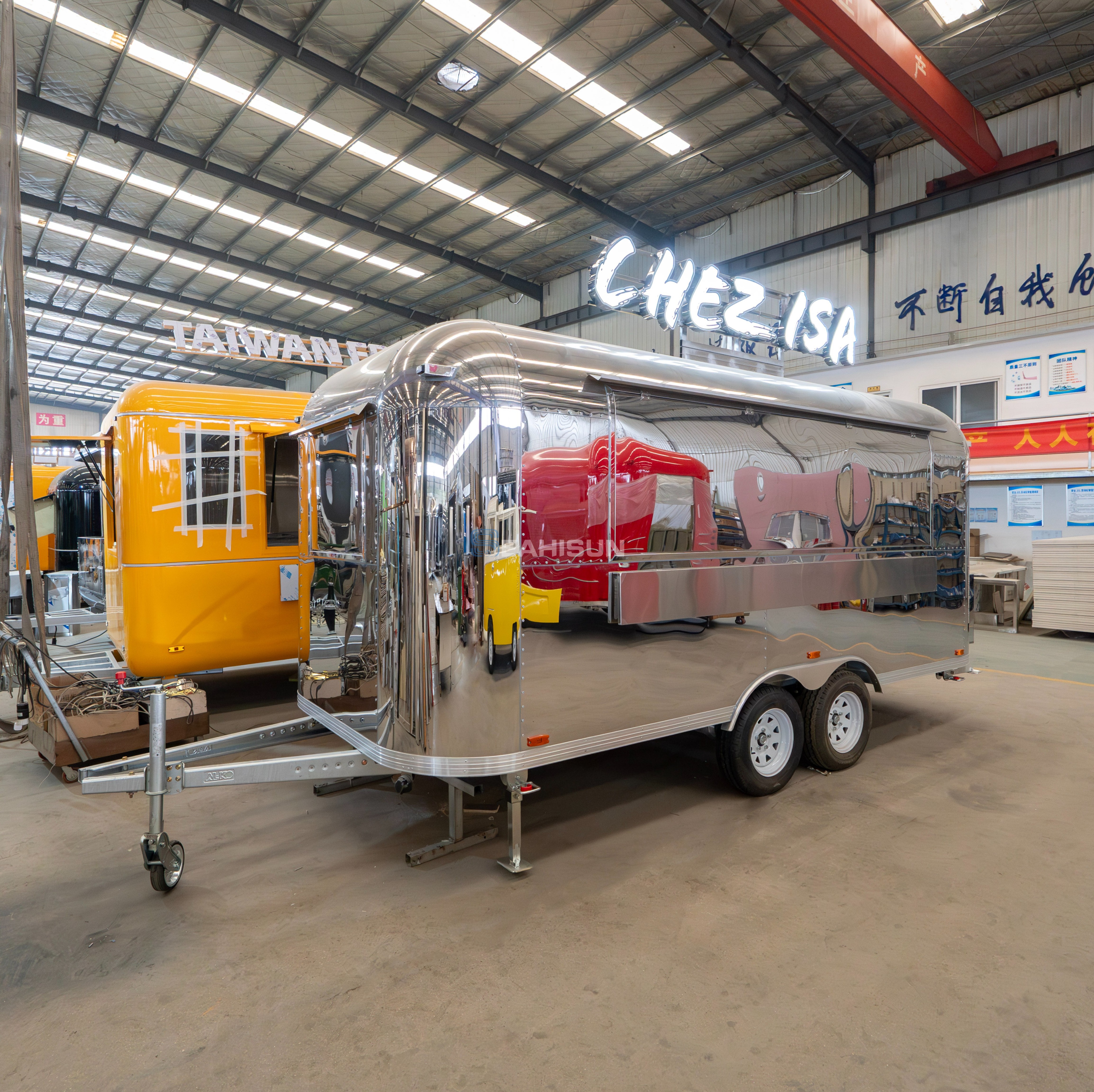
Polished aluminum shines brilliantly under event lights. This retro-futuristic aesthetic acts as an organic lead generator. People naturally gravitate toward shiny, unique objects. A genuine Airstream trailer stops foot traffic effortlessly. It creates an irresistible photo opportunity for attendees. Consumers will pull out their phones instantly. They will share your brand on social media purely because they love the vehicle's classic shape.
Consumers hold strong psychological associations regarding these vehicles. They view them as premium and bespoke. They associate the curved metal look alongside luxury lifestyle experiences. If your brand sells high-end coffee or artisanal goods, this matches your identity perfectly. The vehicle elevates your product's perceived value immediately. You gain a powerful "halo effect" simply by serving out of an iconic shell.
However, beauty carries a steep operational price. You must carefully navigate several severe limitations when choosing this route. Common implementation risks include:
Boxy designs prioritize pure function over form. The 90-degree angles allow for standard commercial equipment installations. You can bolt maximum overhead storage cabinets easily into the straight walls. A standard square food trailer optimizes prep lines perfectly. Your staff can move efficiently. They never hit their heads on sloping ceilings. Straight walls accommodate standard 30-inch deep commercial prep tables seamlessly.
Flat exterior surfaces provide incredible marketing value. They serve as ideal, unobstructed billboard space for your brand. You can apply full vinyl wraps smoothly without distortion. These flat panels support aggressive branding campaigns beautifully. You can mount dynamic digital menu boards directly onto the flat side. Every square inch works hard for your marketing team.
Utility does have its own specific downsides. You must consider these drawbacks before finalizing your purchase strategy.
| Spatial Metric | Curved Shell (Airstream) | Box Shell (Square) |
|---|---|---|
| Overhead Storage | Severely limited by curved roof lines. | Maximum capacity. Full standard cabinets fit easily. |
| Equipment Fit | Requires low-profile or heavily modified appliances. | Accepts standard commercial restaurant equipment. |
| Exterior Branding | Difficult to wrap. Relies on polished metal aesthetics. | Perfect blank canvas. Easy and cheap to wrap. |
| Staff Headroom | Restricted near the outer walls. | Uniform height throughout the entire interior. |
The debate between a Airstream food trailer vs square food trailer comes down to five critical factors. We evaluate these differences strictly to guarantee maximum return on investment. You must weigh these elements against your operational capabilities.
Custom vintage units demand high initial capital expenditure. You pay heavily for the rare shell and the complex retrofit labor. However, they hold remarkable resale value over decades. Vintage models often appreciate as collector assets. Square builds offer a highly accessible starting price point. They require less specialized labor to build. However, they depreciate predictably over time. They behave exactly like standard commercial fleet vehicles in the resale market.
Your interior volume directly dictates your menu complexity. Dual 40-pound fryers and full-size convection ovens fit easily inside square layouts. The straight walls accommodate standard commercial equipment depths without issue. Conversely, curved shells require highly modified or compact equipment. The curved walls push equipment forward into your aisle space. You must shrink your menu drastically to fit the vehicle.
Sourcing a pristine vintage shell takes months. Custom-building the curved interior adds even more time to your timeline. Fabricators must scribe every single cabinet to match the wall curvature perfectly. Standardized units use a rapid-assembly process. Fabricators build square boxes quickly using predictable, readily available materials. You launch your brand activation much faster when choosing a square build.
Custom restorations often face extreme bureaucratic scrutiny. Health inspectors question custom water tank placements and unusual plumbing runs. They examine washable surface continuity on curved walls very closely. Purpose-built square units pass health inspections easily. Factories build them specifically to meet modern national health codes. They feature standard coved corners and seamless flooring straight from the assembly line.
Event organizers assign strict spatial footprints for pop-ups. A heavy, lengthy retro unit requires a massive turning radius. It also carries a heavier towing weight due to the custom interior steel framing required for stabilization. Square units often maximize interior space while maintaining a smaller, more manageable exterior footprint. You can maneuver them into tight festival spaces much easier.
Many operators try to save money upfront by purchasing the smallest unit possible. This represents a massive operational mistake. The false economy of "cheap" ruins businesses quickly. Under-sizing a square trailer creates immediate operational bottlenecks. Over-compressing a heavy, complex menu into a small vintage shell destroys your output. These bottlenecks cannibalize your daily revenue directly.
You lose more money in missed sales during a single busy weekend than you saved on the initial purchase price. Interior flow directly impacts employee fatigue. A cramped kitchen forces your staff to cross paths constantly. They bump elbows. They drop food. Order turnaround times slow down drastically during peak pop-up rushes. Proper staffing ergonomics keep your team fresh. Fast service generates consistently higher profits.
You must project your future growth accurately using a strict scalability framework. The aesthetic draw of a shiny shell might bring fifty extra people to your window. However, can your kitchen serve them? If curved walls slow your service times, that crowd will walk away in frustration. An optimized straight-wall line pushes tickets incredibly fast. Adding just 15 seconds to a ticket costs you hundreds of dollars during a two-hour lunch rush.
Your final choice hinges entirely on one core performance indicator. Are you optimizing your pop-up for brand impressions or transaction volume? Choose the retro aesthetic for premium impressions, photography, and sampling. Choose the boxy utility for heavy menus, maximum transaction volume, and speed.
Stakeholders must finalize their menu and activation flow immediately. You must secure your local health department baseline guidelines today. Complete these crucial steps before approaching any builders. Your menu always dictates your equipment. Your equipment always dictates your required floor plan.
Do not make this expensive operational decision blindly. Consult directly with a custom fabrication specialist today. Ask them to provide a detailed spatial planning checklist for mobile kitchens. Protect your investment by planning your interior layout perfectly from day one.
A: Square trailers are generally easier to get approved. Fabricators purpose-build them strictly for modern health codes. They feature standard washable surfaces and easy plumbing access. Airstreams require precise, custom retrofitting. You must carefully manipulate plumbing and ventilation standards to fit curved walls, which inspectors scrutinize heavily.
A: Yes, you can fit a commercial kitchen inside one. However, it requires highly customized, low-profile equipment. You absolutely must sacrifice vertical storage. The sloped ceilings prevent standard tall refrigerators and commercial exhaust hoods from sitting flush. You have to adapt your menu to fit the smaller equipment footprint.
A: Airstreams retain their resale value much better over time. This happens due to their general scarcity and classic design appeal. They maintain enduring demand in the mobile retail trailer market. Standard box trailers depreciate predictably like normal commercial vehicles, whereas vintage shells often appreciate as coveted collector assets.
A: Yes, they are significantly easier and cheaper to wrap. Flat panels provide a perfect blank canvas for vinyl applicators. Installers apply the graphics quickly without stretching or distortion. In contrast, wrapping the riveted, curved aluminum surfaces of a vintage shell requires specialized labor, extra time, and higher installation costs.

 注: 建议图片大小150px*50px

